Showing posts with label information. Show all posts

January 20, 2013

The Smartphone Have-Nots - NYTimes.com

A reasoned piece about the two main theories to explain the increase in income inequality during the last couple of decades. I firmly believe that technology is at the heart of this phenomenon because the information technology revolution has empowered high skilled and highly motivated individuals to grab this golden ring.

Meanwhile, others with less intellectual capacity, motivation, skills, unwillingness to move, or inability to pay for educating themselves have not been able to keep up resulting in lower paying jobs.
Another factor at work is the super-rich have leveraged their higher incomes into investment portfolios that have resulted in substantial income from capital gains, dividends, etc, which are taxed at a lower rate.

Income inequality is not inherently evil unless it results in repression. Nevertheless, the democracy is at risk and politicians will continue to fight over its causes and remedies.


The Smartphone Have-Nots - NYTimes.com:

 "....After Mishel finished his presentation, David Autor, one of the country’s most celebrated labor economists, took the stage, fumbled for his own PowerPoint presentation and then explained that there was plenty of evidence showing that technological change explained a great deal about the rise of income inequality. Computers, Autor says, are fundamentally different. Conveyor belts and massive steel furnaces made blue-collar workers comparatively wealthier and hurt more highly skilled crafts­people, like blacksmiths and master carpenters, whose talents were disrupted by mass production. The computer revolution, however, displaced millions of workers from clerical and production occupations, forcing them to compete in lower-paying jobs in the retail, fast-food and home health sectors. Meanwhile, computers and the Internet disproportionately helped people like doctors, engineers and bankers in information-intensive jobs. [emphasis added] Inequality was merely a side effect of the digital revolution, Autor said; it didn’t begin and end in Washington......"

'via Blog this'

January 10, 2012

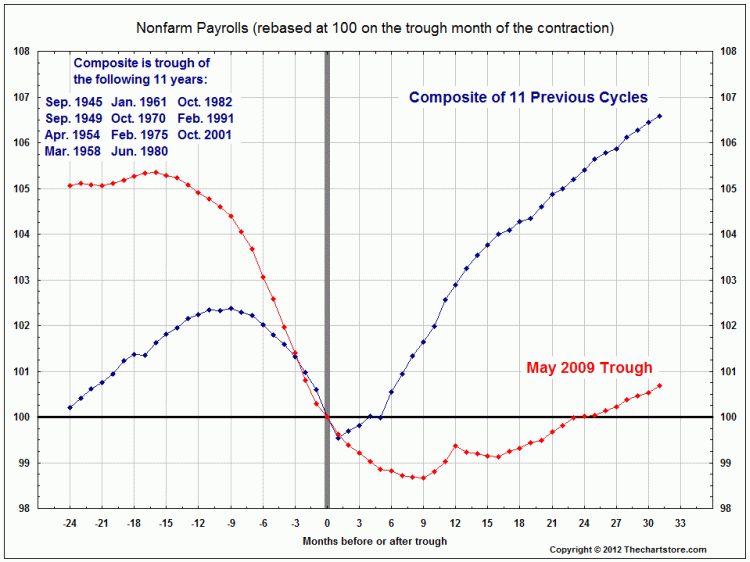
Slow Job Recovery - More Technology, Less Labor

(Chart courtesy of "The Big Picture " blog (Ritholtz); originally from thechartstore.com)

The chart below shows that the recovery from this Great Recession as measured in jobs is considerably slower than the composite of all periods since WWII. Why is this?

My reading and observation convinces me that we are in a period of what I'll call rapid digital productivity (RDP).

We have been through massive technological change in the past, e.g., from manual labor to steam, the Industrial Revolution, and electrification where job dislocation occurred. Employment rebounded because the average Jane and Joe could learn new skills relatively quickly and adapt to the requirements of a new work environment and different industries. Training and apprenticeships enabled most people to cope so that they became employable and could earn a decent wage in these new or expanded industries.

More recently in the 20th Century, institutions such as public education, government, private sector, and union training programs helped people learn new skills and find new jobs in basically the same economy that existed in the former 'good times.'

I believe this era in the 21st Century is different. As digital technologies, massive networks of information, quantum leaps in software capability, miniaturization, robotics and other advances in digital/computer technology (RDP) pervade more industries, the actual work available that requires humans to perform is shrinking. Businesses are finding that they can easily substitute capital investment in these RDP technologies for labor. The inputs required for the same or increased output have become far less labor intensive. That means fewer jobs while growth, albeit more slowly, occurs.

I think we are in the midst of a massive transformation that will continue to reduce the need for labor to produce the goods and services that we need to live reasonably well. Machines and systems will continue to eliminate labor as the RDP technologies are more broadly deployed. Thus, the recovery and growth in the economy to create jobs will be far slower than promised by politicians of all stripes.

Many simply do not understand the radical transformation underway. They may believe that we will return to the 'old days' when jobs came back when a  recession ended. Some leaders prefer to talk about the hollowing-out of the middle class and blame the 'rich' as the problem, seeking a redistribution of wealth as a panacea. The problem is far deeper than that polarizing rhetoric and the solutions exceedingly more difficult than simply changing Presidents or members of Congress.

What has worked historically such as government stimulus and deficit spending may have a short term positive impact by pumping money into the economy. Demand for goods and services and some job growth may result, but this will not suffice for the long term because of the radical nature of the RDP technological transformation underway.

Instead, we need a basic re-thinking of the nature of work and the institutions that provide people the skills and resources to work productively in an economy that has declining need for the traditional skills of middle-class people. The inertia of our institutions far exceeds the increasing momentum of technological change.


A recent (January 2012) analysis of jobs and income in Vermont by the Public Assets Institute fails to even allude to the effects of technology (RDP) in the hollowing out of the middle class in the past decade or two, preferring to resort to political and policy reasons. This leads me to believe that many simply do not understand the deep effect that technology has had on the nature of work and middle class jobs in America.

November 15, 2011

Search can't scale without social, and Bing has Facebook and Twitter on its side | TechRepublic

The massive amount of information that humankind creates is becoming evermore difficult for search engines to master. This story examines what Bing and Google are up to to.
" throughout all of human history up until 2003 we created 5 exabytes of data (five billion gigabytes). We now create that much every day. In 2011, we’ll create 1.8 zettabytes of data (a zettabyte is a 1000 exabytes). That’s up from 1.2 zettabytes in 2010, and we’ll be creating over 20 times that by 2020."

'via Blog this'

February 17, 2011

Watson's Natural Language Capability is a Tremendous Advance in Technology

Watson's overwhelming Jeopardy victory over humans this week is some of the best possible publicity for IBM.

We will soon see this technology applied to a number of tough data and information problems, beginning, most likely with medecine.

November 12, 2010

Who Owns and Controls Personal Information & Identities

My position: I own any data that I choose to share with any organization. A company or organization that unduly restricts my access to it or my free choice about how to share it is evil.


This excerpt form The Economist story:
"Both Google and Facebook are run like absolute monarchies in which hundreds of millions of users (digital serfs, some might say) have created identities. Rather like mercantilist countries in the offline realm, both companies operate policies to protect this asset. Google stoked the trade war because it wants to add what it calls a “social layer” to existing products such as picture-sharing and e-mail, making it look more like Facebook. It would help Google if users could bring their contacts to its services from other sites. But Facebook, the world’s biggest social network, wants to keep control of its serfs’ data and therefore stops them exporting contacts easily."

October 11, 2010

Web Upgrade HTML 5 May Weaken Privacy - NYTimes.com

Web Upgrade HTML 5 May Weaken Privacy - NYTimes.com:


The cycle is never ending. New technology promises greater user convenience and capabilities. While we have an advertising model supporting the 'information wants to be free' expectation of the Internet, that convenience comes with a privacy price.

Please, gurus and privacy wonks, get this as right as you can. I certainly don't want government regulation of this domain. That will be worse than the abuses we may complain about.

"In the next few years, a powerful new suite of capabilities will become available to Web developers that could give marketers and advertisers access to many more details about computer users’ online activities. Nearly everyone who uses the Internet will face the privacy risks that come with those capabilities, which are an integral part of the Web language that will soon power the Internet: HTML 5."

May 3, 2009

Encyclopedic Knowledge

A new knowledge search and analytics engine, Wolfram Alpha, will formally launch in a few days. This revolutionary search tool is remarkably different than Google, Yahoo Search or Mocrosoft Live search. Instead of presenting sites in a prioritized list according to built-in algorithms, WA will respond on-the-fly with encyclopedic type answers to direct questions. A UK newspaper has the story.

Dr. Wolfram's demonstration of his powerful system, based on artificial intelligence concepts and curated data, at Harvard's Berkman Center for Internet and Society last week was a hit with Internet experts.

Coincidentally, The New York Times chronicled the rise and demise of Encarta, Microsoft's 1980s-90s CD and Internet based encyclopedia. The world of knowledge continues to morph and reshape itself into much more than one could ever have predicted even 20 years ago.

The interesting commonality between Encarta and all other first-rate encyclopedias, whether books or electronic, including Wolfram Alpha, is they are curated by experts. Wolfram predicts that 1,000 people will be needed to acquire and maintain the numerous databases that underlie WA, which will use information that is not always available to spiders used by search engines to crawl the Internet gathering updates to websites for their indexes. Even Wikipedia the 'crowd-based' online gem has hundreds of volunteers who scour the millions of entries doing their best to prevent flagrant falsehoods.

We'll be anxious to take Wolfram Alpha for a spin when it's launched. Should Google or Microsoft or Yahoo be worried about this impressive start-up? I don't think so, because if the technology is as good as the hype, one of the major players will buy WA. This will be a fascinating game to watch.

April 18, 2009

Transformation of Medicine and Biotechnology

We are making that inexorable move toward medicine informed by biotechnology and enabled by a common (hopefully), sharable, individual, digital medical record. This is the so-called third revolution in biotechnology and medicine following the description of DNA by Watson and Crick 50 years ago and the identification of the human genome 10 years ago.

The Economist describes it all in
this story ending with:

"The coming convergence of biology and engineering will be led by information technologies, which in medicine means the digitisation of medical records and the establishment of an intelligent network for sharing those records. That essential reform will enable many other big technological changes to be introduced.


Just as important, it can make that information available to the patients too, empowering them to play a bigger part in managing their own health affairs. This is controversial, and with good reason. Many doctors, and some patients, reckon they lack the knowledge to make informed decisions. But patients actually know a great deal about many diseases, especially chronic ones like diabetes and heart problems with which they often live for many years. The best way to deal with those is for individuals to take more responsibility for their own health and prevent problems before they require costly hospital visits. That means putting electronic health records directly into patients’ hands"

February 13, 2008

Senate Votes to Expand Spy Powers - New York Times

Common sense reigns, for a change, in the Senate, no thanks to our two Vermont senators. Now the House should promptly agree with the major provisions of the Senate bill. Since this bill gives the President the power and discretion for surveillance, Senator Obama and Senator Clinton who did not vote on it, but said they would have opposed it, could choose not to implement it, should one of them be elected. Their pandering to the liberal left is obvious.

Granting immunity against the lawsuits brought against the telecom companies is absolutely the right thing to do in the wake of 9/11.

"The bill, which had the strong backing of the White House, allows the government to eavesdrop on large bundles of foreign-based communications on its own authority so long as Americans are not the targets. A secret intelligence court, which traditionally has issued individual warrants before wiretapping began, would review the procedures set up by the executive branch only after the fact to determine whether there were abuses involving Americans.

“This is a dramatic restructuring” of surveillance law, said Michael Sussmann, a former Justice Department intelligence lawyer who represents several telecommunication companies. “And the thing that’s so dramatic about this is that you’ve removed the court review. There may be some checks after the fact, but the administration is picking the targets.”

The Senate plan also adds one provision considered critical by the White House: shielding phone companies from any legal liability for their roles in the eavesdropping program approved by Mr. Bush after the Sept. 11 attacks. The program allowed the National Security Agency to eavesdrop without warrants on the international communications of Americans suspected of having ties to Al Qaeda.

AT&T and other major phone companies are facing some 40 lawsuits from customers who claim their actions were illegal. The Bush administration maintains that if the suits are allowed to continue in court, they could bankrupt the companies and discourage them from cooperating in future intelligence operations."

Senate Votes to Expand Spy Powers - New York Times

December 23, 2007

Graphical Presentation of Complex Data

I stumbled upon this video (others like it are available on YouTube or at the Gapminder site)and if you're interested in more of this Swede's amazing graphical analysis of statistical data about what's happening in the countries of the world, go to www.gapminder.org.

Google has recently acquired the software and the programmers who created it. We should hope to see more from them on this creative way of 'organizing the world's information.'