Showing posts with label economics. Show all posts

January 18, 2014

The future of jobs: The onrushing wave | The Economist

The future of jobs: The onrushing wave | The Economist:

We are in for a long , difficult economic and societal dilemma as spelled out in this piece. The political expression of it is the growing gap between the rich and the poor and the hollowing out of the middle class that politicians bloviate about without offering any real solutions. Perhaps they fail to understand or believe the underlying problem, opting instead to try and legislate job growth..

I'm reading this book, The Second Machine Age: Work, Progress, and Prosperity in a Time of Brilliant Technologies,  referenced in the Economist story, which provides deep insight about the disruption of the traditional economic expectations.

"In a forthcoming book Thomas Piketty, an economist at the Paris School of Economics, argues along similar lines that America may be pioneering a hyper-unequal economic model in which a top 1% of capital-owners and “supermanagers” grab a growing share of national income and accumulate an increasing concentration of national wealth. The rise of the middle-class—a 20th-century innovation—was a hugely important political and social development across the world. The squeezing out of that class could generate a more antagonistic, unstable and potentially dangerous politics.
The potential for dramatic change is clear. A future of widespread technological unemployment is harder for many to accept. Every great period of innovation has produced its share of labour-market doomsayers, but technological progress has never previously failed to generate new employment opportunities."
I believe it's different this time because of the blinding pace of technological change and the ability to explore new models of productivity, work and service, nearly all of which reduce the human labor content in many previously 'safe' occupations.

Our institutions are more deeply entrenched and harder to change. Poorly educated people do not stand a chance for their insufficient skills to command a good-paying job in this new economy. With more generous government benefits, the incentive to work disappears from most folks.

'via Blog this'

September 3, 2013

Not Really Labor's Day - NYTimes.com

Not Really Labor's Day - NYTimes.com: "The lack of any fiscal stimulus aimed at lowering unemployment has contributed to this trend. Ironically, the Federal Reserve’s policy of quantitative easing to stimulate the economy and lower unemployment – which some Republicans tried unsuccessfully to outlaw — has probably also benefited those at the top more than those at the bottom. Lower interest rates have driven up the price of stocks, but left those dependent on less risky sources of investment income (such as savings accounts and bonds) stranded with low returns."

+++++++++++++++++++++++++++++++++++
Accelerated adoption of digital technology (reduction in the labor component) and globalization (lower priced labor component) on the classical economic definition of productivity has favored capital investment and its returns. These megatrends have disrupted the expectations and requirements for workers.

This is why I believe the historic Keynesian economic theory that government 'stimulus' will goose the economy no longer works as it has in the past.

The Fed's stimulus efforts (low interest rates, QE, etc.) have fallen short of expectations and have benefited capitalists far more than labor because of the two mega-factors mentioned above.

Add to these difficulties the inertia of the education system and we have a dispirited workforce ill-prepared for today's and tomorrow's economy.

June 25, 2013

How Technology Is Destroying Jobs | MIT Technology Review

How Technology Is Destroying Jobs | MIT Technology Review: "­Brynjolfsson, a professor at the MIT Sloan School of Management, and his collaborator and coauthor Andrew McAfee have been arguing for the last year and a half that impressive advances in computer technology—from improved industrial robotics to automated translation services—are largely behind the sluggish employment growth of the last 10 to 15 years."

I read Brynjolfsson and McAfee's book in 2011 and remain persuaded they are correct in their analysis. This piece in the MIT Technology Review is highly recommended reading and, of course, the hundreds of comments following in are equally insightful. Read the book if you have the inclination.

I am also convinced that nearly all our policy-makers and politicians are clueless about what to do about the job dislocations in the short term. Meanwhile, government policies are driven not by reality, but by perceived political power and gains. Traditional thinking that the Great Recession will end and things will improve for the U.S. based on past history is likely wrong, particularly so Keynesian economics which drives so much government policy and spending which does not produce the same results as previously. The fundamentals have changed.

Some experts argue (Harvard economist Lawrence Katz in this piece argues that this technological upheaval of the past two decades is merely part of a long term trend that began with the Industrial Revolution.) this is just a continuation of the technological progress of mankind

I think we are in a period of profound change driven primarily by advances in software and extremely capable and fast hardware that can mine and capture the value of 'Big Data.' The combination of technologies is creating capacity and capabilities that supplant the need for more and more human labor to produce goods and services that drive the economy.
"W. Brian Arthur, a visiting researcher at the Xerox Palo Alto Research Center’s intelligence systems lab and a former economics professor at Stanford University, calls it the “autonomous economy.” It’s far more subtle than the idea of robots and automation doing human jobs, he says: it involves “digital processes talking to other digital processes and creating new processes,” enabling us to do many things with fewer people and making yet other human jobs obsolete."
The wild card of course is that the negative effects of technology on jobs is seen mostly in advanced economies and less so in the underdeveloped world where manual processes prevail. The big question is will these countries and peoples grab the advantages of these advances in technology and raise their living standards or will religious, ethnic and cultural factors retard economic gains and better living conditions?

From the Story:

WHY IT MATTERS

Economic theory and government policy will have to be rethought if technology is indeed destroying jobs faster than it is creating new ones.

June 15, 2012

Where Paul Krugman, Keynes are vulnerable - Howard Gold's No-Nonsense Investing - MarketWatch

Howard Gold Believes Krugman and Keynes are Wrong for Today's Economy.  I agree.


I believe America's unemployment is structural for a number of reasons, not the least of which is the impact of technology.


Growing the economy is complicated by the structural changes and dislocations from accelerating technological change which are ‘eating’ traditional jobs,  jobs that previously required humans, previously low-skill, low-priced humans. What’s happening now is that even higher skills are being replaced by technological efficiencies.

Already in many industries and occupations, we have seen that digital and robotic technologies have permanently displaced jobs and skills. With investments in these technologies companies can increase economic output without the corresponding labor component that was both expected and experienced experienced by workers in the past as America exited economic doldrums. The upshot is that many jobs simply will not return and the doldrums are more or less permanent.

As only one example among many, think about the implications in the not too distant future of cars and trucks that drive themselves more adroitly and safely than people can. Google and several other companies are developing such vehicles and as states allow them to to be registered and operated, we can expect more jobs to disappear.

The high skills required to service this new economy are in short supply because the education system lags behind the pace of technological change. Meanwhile, our self gratifying culture works against people desiring to be equipped to work hard to succeed. The ‘entitlement mentality’ pervades far too many lives. We see it in the growing expectations of a government that cannot afford these demands in an economy that is predicted to grow at half its historic rate into the future.


"But what if the problem isn’t only a dearth of demand? Krugman is adamant that current U.S. unemployment is not structural — i.e., that it has deeper causes such as a mismatch of skills between workers and the available jobs.
“…Structural unemployment is a fake problem, which mainly serves as an excuse for not pursuing real solutions,” he wrote. “…All the facts suggest that high unemployment in America is the result of inadequate demand — full stop.”
Actually, economists are divided on this issue — studies by the Chicago and San Francisco Fed support Krugman, while a recent International Monetary Fund paper pegged the structural contribution to long-term U.S. unemployment at 40%. That’s two million people, hardly trivial."
'via Blog this'

March 12, 2012

Gas prices sink Obama’s ratings on economy; bring parity to race for White House - The Washington Post

Somewhere out there in the media cloud we'll read some speculation that high gas prices is a Republican plot from Big Oil interests designed to unseat TeamObama. Nasty speculators are obviously trying to orchestrate his defeat in this rabid election year.


Or, that Obama secretly likes high gas prices so that alternative energy zealots and environmentalists will be mollified and more subsidies can flow to the renewables industry to save the planet while more campaign contributions will flow to Obama's re-election coffers.
OTH, perhaps it's part of a normal economic cycle of supply and increasing world demand exacerbated by threats that the flow from Iran will be disrupted either by boycotts or military actions.


Ahhhh...the politics of economics, a never ending clash of campaign reality with the dismal science and fodder for pundits.
"Disapproval of President Obama’s handling of the economy is heading higher — alongside gasoline prices — as a record number of Americans now give the president “strongly” negative reviews on the 2012 presidential campaign’s most important issue, according to a new Washington Post-ABC News poll.
Increasingly pessimistic views of Obama’s performance on the economy — and on the federal budget deficit — come despite a steadily brightening employment picture and other signs of economic improvement, and they highlight the political sensitivity of rising gas prices."

January 10, 2012

Slow Job Recovery - More Technology, Less Labor

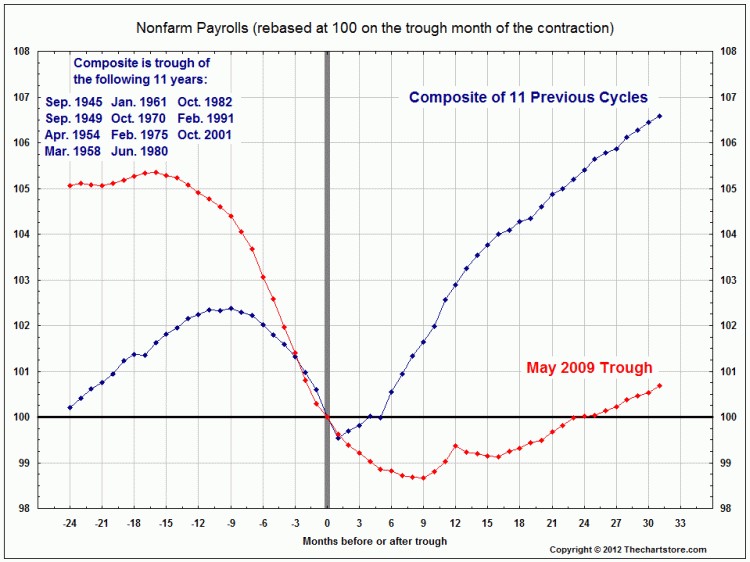
(Chart courtesy of "The Big Picture " blog (Ritholtz); originally from thechartstore.com)

The chart below shows that the recovery from this Great Recession as measured in jobs is considerably slower than the composite of all periods since WWII. Why is this?

My reading and observation convinces me that we are in a period of what I'll call rapid digital productivity (RDP).

We have been through massive technological change in the past, e.g., from manual labor to steam, the Industrial Revolution, and electrification where job dislocation occurred. Employment rebounded because the average Jane and Joe could learn new skills relatively quickly and adapt to the requirements of a new work environment and different industries. Training and apprenticeships enabled most people to cope so that they became employable and could earn a decent wage in these new or expanded industries.

More recently in the 20th Century, institutions such as public education, government, private sector, and union training programs helped people learn new skills and find new jobs in basically the same economy that existed in the former 'good times.'

I believe this era in the 21st Century is different. As digital technologies, massive networks of information, quantum leaps in software capability, miniaturization, robotics and other advances in digital/computer technology (RDP) pervade more industries, the actual work available that requires humans to perform is shrinking. Businesses are finding that they can easily substitute capital investment in these RDP technologies for labor. The inputs required for the same or increased output have become far less labor intensive. That means fewer jobs while growth, albeit more slowly, occurs.

I think we are in the midst of a massive transformation that will continue to reduce the need for labor to produce the goods and services that we need to live reasonably well. Machines and systems will continue to eliminate labor as the RDP technologies are more broadly deployed. Thus, the recovery and growth in the economy to create jobs will be far slower than promised by politicians of all stripes.

Many simply do not understand the radical transformation underway. They may believe that we will return to the 'old days' when jobs came back when a  recession ended. Some leaders prefer to talk about the hollowing-out of the middle class and blame the 'rich' as the problem, seeking a redistribution of wealth as a panacea. The problem is far deeper than that polarizing rhetoric and the solutions exceedingly more difficult than simply changing Presidents or members of Congress.

What has worked historically such as government stimulus and deficit spending may have a short term positive impact by pumping money into the economy. Demand for goods and services and some job growth may result, but this will not suffice for the long term because of the radical nature of the RDP technological transformation underway.

Instead, we need a basic re-thinking of the nature of work and the institutions that provide people the skills and resources to work productively in an economy that has declining need for the traditional skills of middle-class people. The inertia of our institutions far exceeds the increasing momentum of technological change.


A recent (January 2012) analysis of jobs and income in Vermont by the Public Assets Institute fails to even allude to the effects of technology (RDP) in the hollowing out of the middle class in the past decade or two, preferring to resort to political and policy reasons. This leads me to believe that many simply do not understand the deep effect that technology has had on the nature of work and middle class jobs in America.

January 2, 2012

Nobody Understands Debt - NYTimes.com

Nobody Understands Debt - NYTimes.com

Krugman is the ultimate Keynesian, even winning a Noble prize for his work. He seems also to posess a massive ego because he's so certain that he's right! But what if he and the Keynesians are wrong?

I'm no economist, but I think he's wrong about government spending and debt because today's and tomorrow's economy is unlike that of the past where the theory arguably worked fairly well.

I believe accelerating technological change makes for a very different economic reality than in the past. I am persuaded that we are entering a future where jobs will continue to disappear because human work, even complex human work, will increasingly be done by powerful computing networks and robotic systems. As this change accelerates, the need for workers with the "middle skills" (the middle-class) will continue to diminish while the population grows.

Of course, people will continue to be needed in certain service work such as plumbers, technical service, equipment and infrastructure maintenance and health care. Lower paying work like food service, agricultural labor, gardening, etc. that aren't yet adaptable to automation will certainly be required.

Higher skilled jobs designing and servicing these complex digital and robotic systems will be in short supply, because people are changing and re-skilling more slowly than technology is advancing. Our institutions and education have inertia that is unequal to the momentum of society's adoption of advancing technology. The economy seems to be much more capital than labor intensive for the same output.

More than likely, so-called structural unemployment will not disappear quickly, but may become worse. This means fewer taxpayers and increasing burdens on society's productive people to support those who receive ever-increasing benefits provided by government spending which now requires borrowing about 40 cents for every dollar spent.

Krugman's approach may have worked for yesterday's economy, but will likely fail tomorrow's reality. He offers scant evidence that increasing government spending and debt will produce the kind of skills and jobs that will be essential to success in tomorrow's economy. Presumably, he's not advocating 'make-work' jobs with debt spending. Or is he?

If his theory and advocacy is wrong, we face government growth and costs that we cannot afford.


"...So yes, debt matters. But right now, other things matter more. We need more, not less, government spending to get us out of our unemployment trap. And the wrongheaded, ill-informed obsession with debt is standing in the way."

November 5, 2011

Milton Friedman on Capitalism and the Nature of Man

Milton Friedman understood the fundamental nature of man and his arguments for the economic/political system they should live under...capitalism... is only rebutted by idealists, who wish for something different, not realists. The argument is really about which worldview one embraces: a.) man is inherently good and with the proper governance, can become better; or b.) man is fundamentally wired to pursue his own self interest.


If the latter, then capitalism is the correct approach (as Russia and China have discovered). If the former, as present Europe situation portrays and the failed Russian and Chinese models have shown (socialism, communism), failure is inevitable, because it (the socialist state) is not affordable and, as history has shown, is doomed to fail.


September 24, 2011

The Weekend Interview with Robert Lucas: Chicago Economics on Trial - WSJ.com

A good piece by Mr. Jenkins well worth reading. The notion of 'rational expectations' rings soundly for me as a possible explanation why the economy remains in the doldrums.
"Let's face it, the "Chicago School" of economics—the one with all the Nobel Prizes, the one associated with Milton Friedman, the one known for its t

rust of markets and skepticism about government—has taken a drubbing in certain quarters since the subprime crisis.

Sure, the critique depends on misinterpreting what the word "efficient" means, as in the "efficient markets hypothesis." Never mind. The Chicago school ought to be roaring back today on another of its great contributions, "rational expectations," which does so much to illuminate why government policy is failing to stimulate the economy back to life..."

'via Blog this'

November 8, 2010

Dollar Leakage Spurs Growth Elsewhere -- Seeking Alpha

Dollar Leakage Spurs Growth Elsewhere -- Seeking Alpha

A sensible evaluation by Steven Hansen of the Fed's recent decision, called QE2 (Quantitative Easing, Round 2 [round 1 was TARP]) to buy $600 billion in U.S. Treasury securities during the next 6 months as an attempt to stimulate the economy.

There is widespread disagreement about this Fed decision which was opposed by one of the Fed's board of governors.

Countries such as Germany and China are opposed to what amounts to a devaluation of the dollar by printing money.

If that's not what's going on here, what is?

Hansen says:

"...I was trying to grasp the beneficiaries of this QE2, and could only think of the USA equities market and forex / commodity traders. The belief by many is that the dollar will weaken, and companies with a global footprint will have significantly higher international profit growth (as expressed in USA dollars).
Of course, this line of thinking requires the fundamental belief that other currencies and governments will stand stand idly by while their currency strengthens and their perceived competitive advantage is whittled away. It is much more likely a currency / economic war will follow than foreign countries remaining passive to USA's quantitative easing.
It is fairly easy to identify who will suffer with the current Fed policy:
  • the old who lived on social security, bond yields and the income from their CD's (CD yields are now so low they will barely purchase a six pack of beer); and,
  • the underfunded pension funds who are now denied any low risk fixed income opportunities.
So the burden of this low interest rate policy is being carried by the old (retired) and the boomers (near retired). Our old fashioned retirement income schemes are in the toilet. In theory, it is beneficial to the alphabet soup of generations which follow as they have access to cheap money. If this were only true......."

October 5, 2010

The Fed is dead, maybe by 2012 Paul B. Farrell - MarketWatch


Farrell pulls no punches in this piece. His bottom line message:
"...So who can you trust? Nobody, not me, not even Taleb. Why? In the final analysis the Buddha said it best: “Believe nothing, no matter where you read it or who has said it, not even if I have said it, unless it agrees with your own reason and your own common sense.”
Unfortunately, America is losing its capacity to reason, its common sense, its values, its vision of the future. More of us need to trust Taleb’s “simple metric.”

Taleb, who wrote the Black Swan (I highly recommend this book), has this yardstick:
Did someone predict the last crisis before it happened? ... If the answer is no, I don’t want to hear what the person says. If the person saw the crisis coming, then I want to hear what they have to say’.”
Farrell's dismal scenario [which fails to include other, possibly earth-shaking, dramatic events triggered by terrorism and the likely intensifying clash of Islam and other world religions]:
Stage 1: The Democrats just put the nail in their coffin confirming they’re wimps when they refused to force the GOP to filibuster Bush tax cuts for billionaires.
Stage 2: In the elections the GOP takes over the House, expanding its strategic war to destroy Obama with its policy of “complete gridlock” and “shutting down government.”
Stage 3: Post-election Obama goes lame-duck, buried in subpoenas and vetoes.
Stage 4: In 2012, the GOP wins back the White House and Senate. Health care returns to insurers. Free-market financial deregulation returns. Lobbyists intensify their anarchy.
Stage 5: Before the end of the second term of the new GOP president, Washington is totally corrupted by unlimited, anonymous donations from billionaires and lobbyists. Wall Street’s Happy Conspiracy triggers the third catastrophic meltdown of the 21st century that Robert Shiller of “Irrational Exuberance” fame predicts, resulting in defaults of dollar-denominated debt and the dollar’s demise as the world’s reserve currency.
Stage 6: The Second American Revolution explodes into a brutal full-scale class war with the middle class leading a widespread rebellion against the out-of-touch, out-of-control Happy Conspiracy sabotaging America from within.
Stage 7: The domestic class warfare is exaggerated as the Pentagon’s global warnings play out: That by 2020 “an ancient pattern of desperate, all-out wars over food, water, and energy supplies would emerge” worldwide and “warfare is defining human life.”
In this rapidly unfolding scenario, the Fed cannot survive. Why? Not because the Fed is at the center of America’s economic problems, beyond repair, a dying institution. But because the Fed is a pawn of Wall Street’s Happy Conspiracy, which is incapable of seeing the train wreck that it set up.
This out-of-control, conspiracy of greedy Wall Street bankers, corporate CEOs, corrupt politicians and Forbes 400 billionaires will, in the near future, trigger the third catastrophic meltdown of the 21st century, a collapse that paradoxically can transform America into a new, stronger post-capitalist economy … but only after a revolution and brutal class warfare. But few will talk about what’s coming.

September 26, 2010

The Recession Is Over, Now Where Are the Jobs? -- Seeking Alpha

The Recession Is Over, Now Where Are the Jobs? -- Seeking Alpha


I have been reading Steven Hansen's weekly analyses over time and he makes more sense than most of what we read, particularly in the popular press. Hansen talks about 'headwinds' in the economy, that cannot be fixed by throwing money at it. He's right. We have serious structural problems that are sapping any recovery. Those include: our political apparatus is in disarray and we seem to have lost our way in regards to the beliefs and values that have made America great.
America suffers from a deficit in values and confidence. David Brooks last week writes a bit about one of those deeply personal values, responsibility ["What the country is really looking for is a restoration of responsibility. If some smart leader is going to help us get out of ideological gridlock, that leader will reframe politics around this end."]
I recommend both Brooks and Hansen's writings this week.
Hansen:
"The “highlight” of this week was finding out the recession ended in June 2009. There is no question that data supports that the recession was over based on established definitions. The complete statement is an interesting read due to the rationalization of the decision.
I was hoping the NBER would call an end of recession, while saying at the same time that we were in a depression. Most likely political considerations prevented this call. Still, we are in a depression. (emphasis added)
Based on the recession ending in June 2009, this continues to be the worst recovery since WW2 – not to mention the Great Recession was the worst recession since the Great Depression.
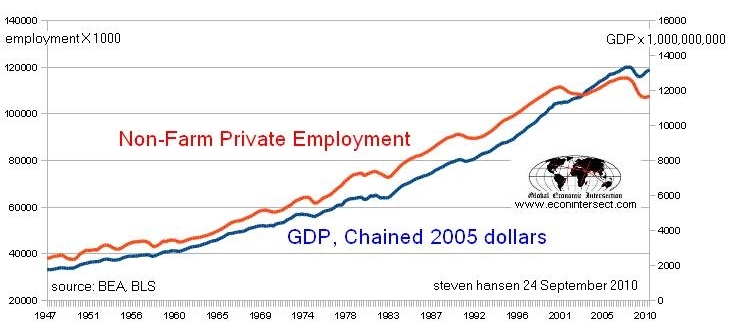
The debate continues on jobs creation. Most want adjustment to monetary policy to spur jobs growth. This debate would have merit if it occurred prior to 2000 but things are different in 2010 – increasing money flows or increasing GDP are no longer directly affecting job creation (click to enlarge):
Even to the most uneducated, it is obvious the economy everyone is measuring runs through money flows and finance – and it has disconnected from jobs and Joe Sixpack. There is something other than money flows providing the headwinds to jobs growth. Our recovery is hostage until those headwinds are attacked. Trying to correct headwinds with money flows cannot solve structural problems. (emphasis added)
What is worse is that our jobs crisis is disproportionately affecting our next generation and overall social order."

June 14, 2010

Mineral Wealth Estimate Excites Afghan Officials - NYTimes.com


Mineral Wealth Estimate Excites Afghan Officials - NYTimes.com:

Here's a game-changer! If mineral assets in Afghanistan are worth a trillion or more dollars, economic opportunity may soon trump radical Islam as the driving force determining the future of the country.

Wouldn't the radical Islamic fundamentalists love to get their hands on this wealth to fund their jihad against the West! The stakes in the Aghan war just rose dramatically!


"According to the report, which was described Monday in The New York Times, Afghanistan has at least $1 trillion in mineral deposits that have yet to be unearthed. It is a potential income source so vast that if it were tapped and the wealth handled in a way to benefit the whole population, the country could be transformed. It would also turn Afghanistan into a mining center.

That would, however, require a substantial change in the country’s circumstances, since many of the reserves were found in politically unstable areas, said Mr. Omar, the Mines Ministry spokesman.

“Mining is not like a shop that you can open and immediately take advantage of,” he said, adding that it would most likely take five to 10 years before the country could begin to use those reserves."
The full Times story is here.

June 10, 2010

Vermont's Lone Congressman on Fox News

Vermont Congressman Welch's call for BP, (a worldwide company based in Great Britain) to eliminate stock dividends and stop advertising (assuming only in the U.S.) meets strong resistance from Neil Cavuto at Fox News.

Is this a typical political ploy by the politician, Welch, to attract attention or does he really believe that the U.S. Congress should be in control of decisions that are legitimately made by a worldwide company's board of directors?

Watch the video and see if you believe that Welch's arguments are economically or legally valid. Cavuto may be baiting Welch, but Welch's arguments seem feeble.

September 6, 2009

Vermont Dairy Farmers Face Stiff Competition

Here's an underlying reason that Vermont's dairy farms are in such deep trouble financially. In addition to the convoluted federal milk pricing/subsidy system, Vermont dairy farmers simply cannot compete effectively by producing a commodity product, bulk milk, with farms of the scale shown in the video below.

March 22, 2009

Response to an Email from a Friend

Our government exists on this basic premise: ".. in Order to form a more perfect Union, establish Justice, insure domestic Tranquility, provide for the common defense, promote the general Welfare, and secure the Blessings of Liberty to ourselves and our Posterity..."


Inherent in this ideal is the expectation that people will be reasonably free to conduct commerce, business and trade to enrich themselves in order to participate in and benefit from the framework of government created under the Constitution.


Certainly much has changed with respect to commerce and government in the intervening centuries, but one thing has not changed. That constant is the nature of Man.


While Man is capable of noble thoughts and deeds, our basic nature is inherently sinful, selfish, and greedy. Else why do we need laws to regulate and punish errant behavior and protect us from each other?  Laws are necessary to control the limits of greed and other destructive behaviors carried to extremes by some.
As long as we expect men and women to provide for their personal and family well-being and to create wages and wealth to be taxed for the 'general welfare and 'common defense,' the inherent traits of 'selfishness and greed' are a far more effective stimulus for individuals than any government decree or general prohibition.


I don't want my government prescribing how I should earn my living, regulating how much money I should earn, how much or how little wealth I can own or what business I can engage in. A framework of laws and sensible regulation for the common good, yes, but our Founders wisely recognized the inherent nature of man and intended that it flourish within a system of necessary  laws and common sense. This is the essence of freedom and an appeal to, but no guarantee of, nobler motives.


Yet because the interconnected systems of banking, finance and commerce have become so entwined and interconnected in this digital age, we are in uncharted territory. This calamitous complexity certainly could not have been envisioned by our Founders, perhaps not even by Mr. Friedman.

To avoid collapse, intervention by government is necessary, but we should recognize they are only human, too, and none of them have been down this road before. To some degree, they are winging it.


I'm not particularly an Obama fan, primarily because of his inexperience and understandable lack of wisdom. Perhaps he will mature in office. I am deeply concerned that 'team Obama' intends to implant an ideological agenda in our country disguised as an economic recovery plan and likely to spend ourselves into servitude to crushing debt and rampant inflation resulting in the country's rapid economic demise.

January 24, 2009

Can Economists Be Trusted? - Economix Blog - NYTimes.com

Can Economists Be Trusted? - Economix Blog - NYTimes.com

This is from a fascinating blog at the NY Times by Princeton Economics Professor Uwe Reinhardt. He writes frequently about health care, but this excerpt is from his recent remarks about now economists frequently bias their statements and products based on a mix of who is paying them and on their personal ideologies.

He "explains how easy it is for economists to infuse their own ideology – or that of their clients – into what may appear to outsiders as objective, scientific analysis."

Caveat Emptor!

"Writing in The New York Times, for example, the Harvard professor N. Gregory Mankiw, former chief of President Bush’s Council of Economic Advisers, makes a case for stimulating the economy through tax cuts rather than added government spending.

First, he suggests that government usually spends money on things people do not want or need – like bridges to nowhere, or digging ditches and then filling them in again. To buttress his case further, he then cites an empirical study by Valerie A. Ramey, according to which the $1 of added government spending will ultimately increase gross domestic product by only $1.40, while according to another recent study by Christina and David Romer, $1 of tax cuts over time increases G.D.P. by $3.

Noneconomists may ask, of course, exactly how a $1 cut in taxes would translate itself into a $3 increase in G.D.P. at a time when traumatized households, whose wealth has been eroded, might use any new tax savings merely to pay down debt or rebuild their wealth through added savings, rather than spend it, and when businesses unable to sell their output even from existing capacity might hesitate to invest such tax savings in more capacity.

But never mind this fine point.

More interesting is that Christina Romer is to be the head of President-elect Barack Obama’s Council of Economic Advisers. In that capacity, last Saturday she released an analysis of fiscal stimulus alternatives, with a co-author, Jared Bernstein. Curiously — or perhaps not — for that analysis, the two authors assume a much larger four-year multiplier effect for added government spending (1.55) than for tax cuts (0.98), although they do confess to a high degree of uncertainty on the actual sizes of these multipliers.

So there you have the flexibility, shall we say, that economists enjoy when they apply their professional skills to affairs of state in what may seem, to outsiders, like purely scientific analyses.

In the first lecture of my freshman economics course at Princeton titled “The Art of Siffing Among Seasoned Adults,” I demonstrate how seasoned adults routinely structure information felicitously (i.e., “sif”) to further their own agenda, and I point out that economists can be among the most skillful practitioners of this art.

“If at the end of this course you still trust me,” I warn them, “I have failed in my mission. When economists advise on public policy, the operative mantra is Caveat Emptor!”

January 16, 2009

Op-Ed Columnist - An Economy of Faith and Trust - NYTimes.com

Op-Ed Columnist - An Economy of Faith and Trust - NYTimes.com

As clever as Brooks is, he fails to mention at least two basic realities that affect how people react to choices.

One is the profound influence of our world of instant communications in which information and money move at nearly the speed of light. In this world, reflective, rational decision making is dramatically altered. Market and economic theories were predicated on slower, more contemplative mental processes. That is not today's reality.

The other key factor is greed. This human trait has always been present, of course, but it has been set loose in markets and financial systems by a not-so-slow erosion of society's morals. "Do your own thing."

His basic point, though, that the mechanistic views of politicians and political ideologies built on outmoded theory are unlikely to help much in the economic recovery. This begs the question: Do we have enough faith to borrow and spend again or are we in a long period of conserve and save? Or the more basic question may be can we realistically grow ourselves out of this recession?

November 23, 2008

Twenty Reasons Why We're Not Consuming - Forbes.com

Twenty Reasons Why We're Not Consuming - Forbes.com:

This piece by Nouriel Roubini, a professor at the Stern Business School at NYU, lists 20 points of concern about the consumer economy and the present recession. This is the last point:


"To bring back the household savings rate to the level of a decade ago (about 6% of GDP) consumption will have to fall--relative to current GDP levels--by almost a trillion dollars. If all of this adjustment were to occur in 12 months, GDP would contract directly by 7% and indirectly (including the further collapse of residential and corporate capital expenditure in a severe recession) by 10%, an exemplification of the Keynesian 'paradox of thrift.' If such an adjustment were to occur over 24 months rather than 12 months, you would still have negative GDP growth of 5% for two years in a row with a cumulative fall in GDP from its peak of 10%. (Note that in the worst U.S. recession since WWII, such cumulative fall in GDP was only 3.7% in 1957-58). One can only hope that this adjustment of consumption and savings rates occurs slowly over time--four years, say, rather than two.

Even in that scenario the cumulative fall of GDP could be of the order of 4% to 5%, i.e., the worst U.S. recession since World War II. Note that the cumulative fall in GDP in the 2001 recession was only 0.4%--and in the 1990-91 recession only 1.3%. So, the current recession may end up being three times as long and at least three times as deep (in terms of output contraction) than the last two."

October 22, 2008

Op-Ed Columnist - Bailout (and Buildup) - NYTimes.com

Op-Ed Columnist - Bailout (and Buildup) - NYTimes.com

Thomas is wringing his hands because gasoline prices are falling. Please tell us, Thomas, what you think the 'correct' price should be for the 'green' future you advocate.

I agree that we need to move much, much more of our energy to renewable sources under our control, but that mix MUST include nuclear. You include it in your ideas, but unless you are willing to advocate strongly for that, all the rest, to use a term from an energy newsletter I receive, are merely 'piddle power.'

If an energy source does not pay its own way over the long term, it won't work. Governments cannot be expected to subsidize the energy industry forever. People should pay for energy like any other purchase, not through a tax.