November 30, 2011

Stocks Surge After Central Banks’ Action on Debt Crisis - NYTimes.com

Sounds like another big bank bailout to me! Let's see what all the talking heads have to say.

 "“They are trying to prevent them from seizing up global liquidity and capital flows and impacting banks and financial institutions throughout the world,” he said.
Burt White, the chief investment officer for LPL Financial, called the liquidity move “a Band-Aid.”
“It helps to prop up the banks for a while, which is going to buy time for Europe to fix the problem,” he said.
The jump in stocks was also an extension of the turmoil and volatility that have weighed on global markets for more than a year."

'via Blog this'

Radio Interview with a High School Classmate

A fascinating radio interview with a high school friend, Michael Manoogian, who went to the RI School of Design then moved to LA to become a first rate logo designer.


Listen to internet radio with Help 2 Succeed on Blog Talk Radio

U.S.Now a Net Exporter of Oil-Based Fuels

[This story is behind the WSJ paywall, so access may be limited]
An interesting and potent development for the U.S., a net importer of refined oil-based products for more than 60 years. I wonder about the economics of this. We are still a huge importer of crude oil at 9 million barrels per day. Yet, after refining, we turn an increasingly larger portion of that into exported products like gasoline and diesel fuel.
Does it make economic sense to ship crude oil here and then turn around and ship refined products abroad? If the prices remain high for refined products, transportation costs must be of less consequence than previously with efficient and massive supertankers. The exports to developing economies must be priced high enough to turn a profit or companies would not do it . Intuitively it seems to make more sense to build and operate refineries closer to the source of the crude oil supplies and the customers for refined products, for maximum efficiency and profitability.
"U.S. exports of gasoline, diesel and other oil-based fuels are soaring, putting the nation on track to be a net exporter of petroleum products in 2011 for the first time in 62 years.
A combination of booming demand from emerging markets and faltering domestic activity means the U.S. is exporting more fuel than it imports, upending the historical norm.
According to data released by the U.S. Energy Information Administration on Tuesday, the U.S. sent abroad 753.4 million barrels of everything from gasoline to jet fuel in the first nine months of this year, while it imported 689.4 million barrels.
That the U.S. is shipping out more fuel than it brings in is significant because the nation has for decades been a voracious energy consumer. It took in huge quantities of not only crude oil from the Middle East but also refined fuels from Europe, Latin America and elsewhere to help run its factories and cars."
USEXPORTS"As recently as 2005, the U.S. imported nearly 900 million barrels more of petroleum products than it exported. Since then the deficit has been steadily shrinking until finally disappearing last fall, and analysts say the country will not lose its "net exporter" tag anytime soon."

November 29, 2011

Secret Fed Loans Helped Banks Net $13B - Bloomberg

A fascinating, well researched story by Bloomberg of the massive bailout of banks during the 2008-2009 financial crisis and the secrecy surrounding it. Kudos to Bloomberg and their authors and editors for doing this. Clearly, the financial system was in jeopardy at the time and bold action was necessary. It's the secrecy that surrounded it that we find so egregious along with the fact that far too many bankers and the industry in general benefited to an unwarranted degree.


I'm no financial expert, but it seems to me that the finance industry and the Fed were in cahoots to keep Congress in the dark and, for the most part, impotent during this crisis. One could argue that haste was necessary and a dysfunctional Congress could not be trusted to do the right thing in a speedy fashion. Yet, what does it say about the resiliency of our democracy in time of crisis?


Sadly, these world-rattling events have further relegated Congress to irrelevancy in a time of financial crisis. We continue to see more of it with failure of the Super Committee to rationally rein in the deficits and debt, part of which arose from the frantic efforts to save the big banks and the financial system from collapse.

 "The Federal Reserve and the big banks fought for more than two years to keep details of the largest bailout in U.S. history a secret. Now, the rest of the world can see what it was missing.
The Fed didn’t tell anyone which banks were in trouble so deep they required a combined $1.2 trillion on Dec. 5, 2008, their single neediest day. Bankers didn’t mention that they took tens of billions of dollars in emergency loans at the same time they were assuring investors their firms were healthy. And no one calculated until now that banks reaped an estimated $13 billion of income by taking advantage of the Fed’s below-market rates, Bloomberg Markets magazine reports in its January issue."

'via Blog this'

November 26, 2011

Banks Build Contingencies for Euro Zone Breakup - NYTimes.com

Markets rule, not Governments!
 "On Friday, Standard & Poor’s downgraded Belgium’s credit standing to AA from AA+, saying it might not be able to cut its towering debt load any time soon. Ratings agencies this week cautioned that France could lose its AAA rating if the crisis grew. On Thursday, agencies lowered the ratings of Portugal and Hungary to junk.
While European leaders still say there is no need to draw up a Plan B, some of the world’s biggest banks, and their supervisors, are doing just that."

'via Blog this'

November 22, 2011

The Two Moons - NYTimes.com

David Brooks provides a clear explanation of the political funk we're in, but fails to to offer a way out, except via a fiscal calamity.
 "...Ronald Brownstein summarized the underlying typography recently in The National Journal: “In Allstate/National Journal Heartland Monitor polls over the past two years, up to 40 percent of Americans have consistently expressed support for the conservative view that government is more the problem than the solution for the nation’s challenges; about another 30 percent have backed the Democratic view that government must take an active role in the economy; and the remaining 30 percent are agnostic. They are open to government activism in theory but skeptical it will help them in practice.”
In these circumstances, both parties have developed minority mentalities. The Republicans feel oppressed by the cultural establishment, and Democrats feel oppressed by the corporate establishment. They embrace the mental habits that have always been adopted by those who feel themselves resisting the onslaught of a dominant culture..."

'via Blog this'

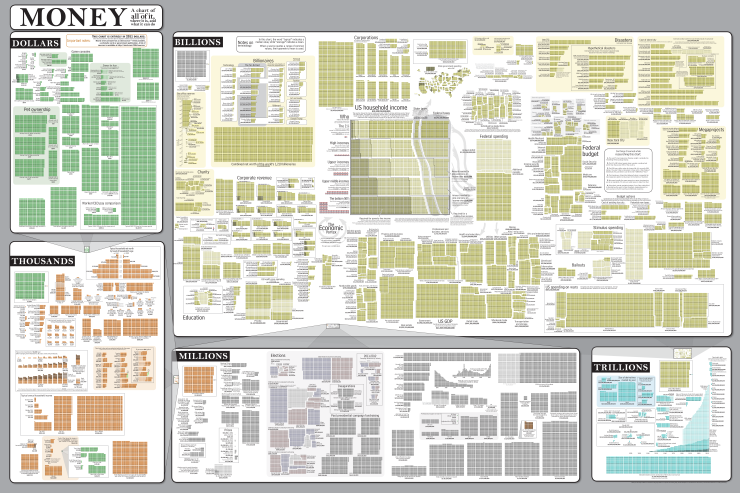
xkcd: Money Chart

xkcd: Money Chart:

A hat tip to The Big Picture for this massive money chart. Check out xkcd.com website to see various comical stuff if you enjoy their humor.


November 21, 2011

How Do You Spell Dysfunctional?

BULLSHIT  is the proper noun for this statement from the co-chairs of the Select/Special/Super Committee charged with finding $1.2 trillion in deficit reduction in the next 10 years as reported in the WSJ (see below).

Obama is the easy target, but it's our Congress that has failed us. No visible leadership will stand up and vote what must be done to correct our fiscal path. The only credible voice, IMHO, is Paul Ryan in the House of Representatives. He speaks truth. Most of he rest speak nothing but empty partisan rhetoric. Will the real leaders please stand up?

Deficit Panel Leaders Fail to Reach Deal

"WASHINGTON — After one last bout of fitful but futile talks, Congressional negotiators conceded the obvious: that the joint Congressional committee charged with drafting a deficit reduction package would miss its deadline this week. But they did not quite give up the ghost of a chance that a solution might be found later.
“After months of hard work and intense deliberations, we have come to the conclusion today that it will not be possible to make any bipartisan agreement available to the public before the committee’s deadline,” said a statement issued late in the afternoon by Representative Jeb Hensarling of Texas and Senator Patty Murray of Washington, the panel’s Republican and Democratic co-chairs.
“Despite our inability to bridge the committee’s significant differences, we end this process united in our belief that the nation’s fiscal crisis must be addressed and that we cannot leave it for the next generation to solve,” they said. “We remain hopeful that Congress can build on this committee’s work and can find a way to tackle this issue in a way that works for the American people and our economy.”"

November 20, 2011

VJ Day Video in Hawaii

A special thank-you to my childhood friend, Mike, now an accomplished graphics artist, for sharing this superb video of the spontaneous celebration when the news broke in August 1945 that Japan had surrendered after years of of bitter warfare in the Pacific region.

As a child, I distinctly remember my father celebrating by blasting the leaves off a tree in the yard with his shotgun. America was ecstatic after so much bloodshed and sacrifice by the 'Greatest Generation' in WWII.


VJ Day, Honolulu Hawaii, August 14, 1945 from Richard Sullivan on Vimeo.

November 15, 2011

Search can't scale without social, and Bing has Facebook and Twitter on its side | TechRepublic

The massive amount of information that humankind creates is becoming evermore difficult for search engines to master. This story examines what Bing and Google are up to to.
" throughout all of human history up until 2003 we created 5 exabytes of data (five billion gigabytes). We now create that much every day. In 2011, we’ll create 1.8 zettabytes of data (a zettabyte is a 1000 exabytes). That’s up from 1.2 zettabytes in 2010, and we’ll be creating over 20 times that by 2020."

'via Blog this'