Showing posts with label David Brooks. Show all posts

December 9, 2011

The Gingrich Tragedy - NYTimes.com

Now that Mr. Gingrich has surged in the polls and is now the front runner, the gloves are coming off as the Republican 'establishment' aims to take him down a peg or two. Noonan in the Wall Street Journal today and here by David Brooks.


Fascinating to observe this pre-primary battle for the Republican nomination. Lots of hand-wringing and gnashing of teeth as we watch Democracy at work! It is truly entrancing to watch grass roots Republicans/conservatives take on the 'establishment' Republicans/conservatives who clearly believe that Speaker Gingrich is unfit to serve as President.

"But they have very different temperaments. Romney, Levin observes, has an executive temperament — organization, discipline, calm and restraint. Gingrich has a revolutionary temperament — intensity, energy, disorganization and a tendency to see everything as a cataclysmic clash requiring a radical response.
I’d make a slightly similar point more rudely. In the two main Republican contenders, we have one man, Romney, who seems to have walked straight out of the 1950s, and another, Gingrich, who seems to have walked straight out of the 1960s. He has every negative character trait that conservatives associate with ’60s excess: narcissism, self-righteousness, self-indulgence and intemperance. He just has those traits in Republican form."

November 11, 2011

The Inequality Map - NYTimes.com

I had never experienced the humorous side of David Brooks. This is hilarious AND poignant.

 "Foreign tourists are coming up to me on the streets and asking, “David, you have so many different kinds of inequality in your country. How can I tell which are socially acceptable and which are not?”"

'via Blog this'

October 18, 2011

The Great Restoration - NYTimes.com

Mainstream America gets it. David Brooks emphasizes that America has the ability to economically self-correct. Let's hope he's right and that his colleague at the NY Times, Mr. Krugman, is wrong as cheerleader for the OWS protestors while advocating for yet more government deficit spending. Fortunately, most Americans disagree with Krugman.
"...Quietly but decisively, Americans are trying to restore the moral norms that undergird our economic system.

The first norm is that you shouldn’t spend more than you take in."

...Second, Americans are trying to re-establish the link between effort and reward.

...The third norm is that loyalty matters.

...Some economists say the government should be spending more now to stimulate a recovery. Thirty-eight percent of Americans seem to agree with that. But 56 percent have said “government spending when the government is already running a deficit is the wrong approach during an economic downturn because it is only a temporary solution that increases long-term debt.”
...These majorities are focused on the fundamentals. They say that repairing the economic moral fabric is the essential national task right now."

October 14, 2011

The Thing Itself - NYTimes.com

Oh for leaders with practical solutions that could cut through the ideological shields that are thrown up by the adherents and reinforced by the various media talking heads and writing fingers.

"Many issues that were once concrete and practical are distorted because they have become symbolic and spiritual. Tax policy isn’t just about how to raise revenue anymore. Liberals see it as a way to punish the greedy and redress the iniquities of capitalism. Conservatives see tax increases as an assault on the enterprising class perpetrated by arrogant central planners. A tax rate could be seen as just a number signifying an expense, but now it’s a marker in a culture war."

'via Blog this'

September 16, 2011

The Planning Fallacy - David Brooks NYT 09/16/11

David Brooks delivers an unwelcome but thoughtful message about the ability of government to manage and move a system as complex as the economy and the resulting disappointments of the governed. We are subjected to far too much political rhetoric these days that is based on the quest for power and control ignoring the reality of the economy's complexity. Brooks argues that, at its best, government is effective on discrete problems, but quick fixes to systemic issues with a myriad of influencing factors cannot be assured.


"...The key to wisdom in these circumstances is to make the distinction between discrete good and systemic good. When you are in the grip of a big, complex mess, you have the power to do discrete good but probably not systemic good.
When you are the president in a financial crisis, you have the power to pave roads and hire teachers. That will reduce the suffering of real people who would otherwise be jobless. You have the power to streamline regulations and reduce tax burdens. That will induce a bit more hiring and activity. These are real contributions.
But you don’t have the power to transform the whole situation. Your discrete goods might contribute to an overall turnaround, but that turnaround will be beyond your comprehension and control.
Over the past decades, Americans have developed an absurd view of the power of government. Many voters seem to think that government has the power to protect them from the consequences of their sins. Then they get angry and cynical when it turns out that it can’t." [emphasis added]

July 26, 2011

Congress in the Lead - NYTimes.com

Do we have a failure of leadership and a triumph of politics in Washington at this critical hour? Did Congress really wrestle control of the the debt crisis from a petulant TeamObama as David Brooks suggests? Of course, over-spending has always been Congress' problem because they have the nation's spending reins under our Constitution.


[Chart from the Wall Street Journal 07/26/11]

Alas, the dream of a Grand Bargain died Friday evening for three reasons.
First, it was always going to be difficult to round up the necessary Congressional votes. Republicans didn’t want the tax increases. Democrats didn’t want the entitlement cuts.
Second, the White House negotiating process was inadequate. Neither the president nor the House speaker ever wrote down and released their negotiating positions. Everything was mysterious, shifting and slippery. One day the president was agreeing to an $800 billion revenue increase; the next day he was asking for $400 billion more. Spending cuts that seemed to be part of the package suddenly seemed hollow. Negotiating partners disappeared.It was phenomenally hard to figure out exactly who was offering what. Democrats in Congress were kept in the dark and were understandably suspicious. It was all a recipe for misunderstandings, hurt feelings and collapse.
Third, the president lost his cool. Obama never should have gone in front of the cameras just minutes after the talks faltered Friday evening. His appearance was suffused with that “I’m the only mature person in Washington” condescension that drives everybody else crazy. Obama lectured the leaders of the House and Senate in the sort of patronizing tone that a junior high principal might use with immature delinquents. He talked about unreturned phone calls and being left at the altar, personalizing the issue like a spurned prom date.
Obama’s Friday appearance had a gigantic unintended consequence. It brought members of Congress together. They decided to take control. The White House is now on the sidelines. Democratic and Republican Congressional leaders are negotiating directly with one another.

October 30, 2010

The Next Two Years - NYTimes.com

The Next Two Years - NYTimes.com:

David Brooks attempts to give advice to President Obama for the next two yewars to repair his sorrowful Presidency. His advice is good, but I fear TeamObama will not embrace it because they are ideologically and politically driven to foster government as the solution rather than the individual and do not embrace the idea or American exceptionalism.

For example, I doubt they understand or will respond to Brooks' third suggestion because their primary political base expects government largess and redistribution of wealth.

"Third, Obama will need to respond to the nation’s fear of decline. The current sour mood is not just caused by high unemployment. It emerges from the fear that America’s best days are behind it. The public’s real anxiety is about values, not economics: the gnawing sense that Americans have become debt-addicted and self-indulgent; the sense that government undermines individual responsibility; the observation that people who work hard get shafted while people who play influence games get the gravy. Obama will have to propose policies that re-establish the link between effort and reward."

September 26, 2010

The Recession Is Over, Now Where Are the Jobs? -- Seeking Alpha

The Recession Is Over, Now Where Are the Jobs? -- Seeking Alpha


I have been reading Steven Hansen's weekly analyses over time and he makes more sense than most of what we read, particularly in the popular press. Hansen talks about 'headwinds' in the economy, that cannot be fixed by throwing money at it. He's right. We have serious structural problems that are sapping any recovery. Those include: our political apparatus is in disarray and we seem to have lost our way in regards to the beliefs and values that have made America great.
America suffers from a deficit in values and confidence. David Brooks last week writes a bit about one of those deeply personal values, responsibility ["What the country is really looking for is a restoration of responsibility. If some smart leader is going to help us get out of ideological gridlock, that leader will reframe politics around this end."]
I recommend both Brooks and Hansen's writings this week.
Hansen:
"The “highlight” of this week was finding out the recession ended in June 2009. There is no question that data supports that the recession was over based on established definitions. The complete statement is an interesting read due to the rationalization of the decision.
I was hoping the NBER would call an end of recession, while saying at the same time that we were in a depression. Most likely political considerations prevented this call. Still, we are in a depression. (emphasis added)
Based on the recession ending in June 2009, this continues to be the worst recovery since WW2 – not to mention the Great Recession was the worst recession since the Great Depression.
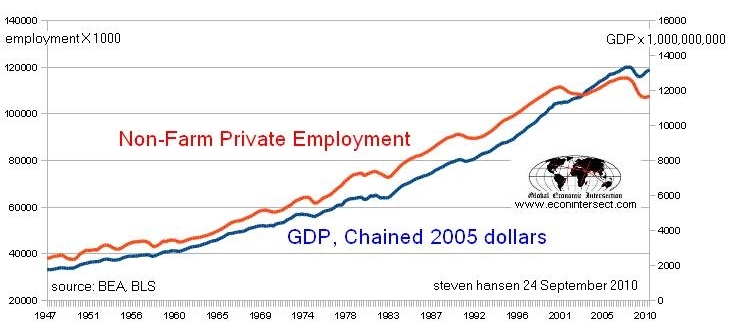
The debate continues on jobs creation. Most want adjustment to monetary policy to spur jobs growth. This debate would have merit if it occurred prior to 2000 but things are different in 2010 – increasing money flows or increasing GDP are no longer directly affecting job creation (click to enlarge):
Even to the most uneducated, it is obvious the economy everyone is measuring runs through money flows and finance – and it has disconnected from jobs and Joe Sixpack. There is something other than money flows providing the headwinds to jobs growth. Our recovery is hostage until those headwinds are attacked. Trying to correct headwinds with money flows cannot solve structural problems. (emphasis added)
What is worse is that our jobs crisis is disproportionately affecting our next generation and overall social order."

June 25, 2010

Op-Ed Columnist - General McChrystal and the Culture of Exposure - NYTimes.com

Op-Ed Columnist (David Brooks)- General McChrystal and the Culture of Exposure - NYTimes.com:

David Brooks' take on the sacking of Gen. McChrystal and the media culture of exposure. The underbelly of public and military service has become the target for media. Do Americans win or lose as a result?

Public servants should understand the salacious nature of today'smedia and not get caught in the trap. We can blame the media if we choose to for the sacking of Gen. McChrystal, but smart people ought to know better than vent to reporters, on or off the record.


"The reticent ethos had its flaws. But the exposure ethos, with its relentless emphasis on destroying privacy and exposing impurities, has chased good people from public life, undermined public faith in institutions and elevated the trivial over the important.

Another scalp is on the wall. Government officials will erect even higher walls between themselves and the outside world. The honest and freewheeling will continue to flee public life, and the cautious and calculating will remain.

The culture of exposure has triumphed, with results for all to see."

May 4, 2010

Op-Ed Columnist - The Limits of Policy - NYTimes.com

Op-Ed Columnist - The Limits of Policy - NYTimes.com

David Brooks has written truth based on research today in the NY Times. Most politicians should pay close attention to the findings and his conclusions. The notion that government policy backed by the government's penchant for erasing poverty by spending massive amounts of money with egalitarian motives is minimally effective. There are far more powerful factors at work in a person's life that determine his/her likelihood of doing well in the world. Read and contemplate David Brooks' column. Your time will be well spent.

September 2, 2009

David Brooks Losing Faith in Obama?

Op-Ed Columnist - The Obama Slide - NYTimes.com:

I have great respect for David Brooks as a journalist and author. Now he has come to realize, and is willing to say so, along with more and more Americans, that TeamObama is alienating millions by his policies and strategy. Brooks now advises TeamObama to "rebalance" because he has turned independents against him and his policies, particularly the wild spending spree that the Democrat Congress and this Administration have undertaken.

But Brooks is dead wrong to believe "Events have pushed Barack Obama off to the left." This man has been on the far left from his time in Congress and prior to that. I'm persuaded that he intends to remake America into a left-leaning socialist country. Some will argue that he needs time to settle in to the job and make the 'changes' he promised. I don't like the changes he has supported and the massive deficits he and Congress, especially the House, have supported. He certainly would be wise to change course, but that may not be possible because he is so leftist and his liberal allies in Congress, led by Pelosi and Reid, drink the same Kool-Aid. For a list of the far left liberal base in Congress, click here.

His charisma has bamboozled many voters who jumped in line to support him for President, mostly as a reaction against President Bush, I think. Obama is ineffective in the job and people will continue to see it and flee his bandwagon as he reveals his true nature and beliefs.

"The president’s challenge now is to halt the slide. That doesn’t mean giving up his goals. It means he has to align his proposals to the values of the political center: fiscal responsibility, individual choice and decentralized authority.

Events have pushed Barack Obama off to the left. Time to rebalance."

July 25, 2009

David Brooks - "Kill the Rhinos!"

In several columns recently David Brooks has been pounding on the failure of the proposed health care reform legislation to restrain costs. I agree with him. Politicians generally prefer pandering to people by telling them that they can have insurance coverage and it won't cost them much, if anything. They don't like talking about cost control.

Brooks is absolutely correct that the rhino in this system is cost inflation and it must be tamed. Any legislation that fails to do this is folly.

In Vermont, which is no exception to cost growth, one has only to look at job growth. It is higher in the health care industry, (followed by education) while nearly all other job categories are shrinking. This fact alone points to one reason health care costs are out of control. Costs must be restrained and at the end of the day, painful though it may be, rationing of services and procedures is inevitable.

Where's the debate on how that should happen? Even Brooks doesn't discuss it. Everyone prefers to talk about incentives, disincentives, access and quality. The only point that gets close to the need for rationing is changing the fee-for-service system to something that rewards quality. Those are code words for rationing. If doctors and hospitals don't get paid for procedures and tests, they won't do them. That's a form of rationing.

"Not everything is compatible with everything else. But the point is that you have rhinos at the door! You’ll try anything that works. You want a political class that no longer perpetuates the myth that people can get everything for nothing. You know that it was political pandering that got us into this mess in the first place.

Obama is right. Things will be bad if we don’t tackle the problem this year. Things will be worse if we add to the costs without beating the rhinos."


A hero in the war against fiscal irresponsibility is David Walker, former Comptroller General of the United States for many years. Here's what he had to say about health care reform recently on MSNBC.

May 10, 2009

Shift From Spending to Saving May Be Slump’s Lasting Impact - NYTimes.com

Shift From Spending to Saving May Be Slump’s Lasting Impact - NYTimes.com:

Is the difference of opinion about whether higher personal savings has a long term benefit to the country's economic well-being a matter of liberal vs. conservative thinking? It seems to me that profligate spending, unwise use of credit and shoddy decision making at all levels is what got us into this Great Recession. Therefore a more reasoned, disciplined approach to living seems to just what the doctor should order.

Isn't it more sensible to believe that higher personal and household savings increases the real personal wealth of the nation? I suppose this is only so if our government also acts rationally and reduces its spending, too.

I find nonsensical TeamObama's arguments that this bloated spending spree and the huge run-up in the national debt can somehow be reversed in the short term. (He said he intends to cut the deficit in half in 4 years.) Too many people will become dependent on this spending for it to be suddenly reduced.

It's unlikely that we will ever return to the bubble days of steadily increasing asset values. The new post-recession economy will reset itself to a generally lower base of true value, whether via inflation and devaluation of assets or by government fiat that we have to cut back, e.g., reduce carbon usage in favor of much higher cost sources to save the planet.

The following assessment included in the story makes the most sense to me.

"...Despite the immediate jolt to the economy, more personal saving would be a positive step in the long run, analysts say. More saving leads to more investment, which promotes economic growth, which leads to better living standards.

At the family level, social critics, economists and even many consumers seem to agree that a forced financial conservatism may be for the better..."

April 3, 2009

David Brooks on Greed and Stupidity - NYTimes.com

David Brooks summarizes the two dominant views of what caused the financial meltdown. Read his full analysis to understand these two schools of thought.

I don't think its as simple as Brooks describes. There are many sub-themes playing in this tragic opera. Greed may not only be about money. Power and the desire of bankers, lawyers, and Congressional and Executive branch people to 'hold sway' and be 'in charge' is also at work. Remember, these are people with massive egos that need stroking.

The greed and stupidity jingles also played at the bottom of the scale with stupid home buyers unable to afford the ridiculous mortgage terms offered by unscrupulous brokers that played on this stupidity.

For years our culture has been infused with the background hum that borrowing is better than saving and many have bought into the credit culture. Now they struggle with crushing debt. Some argue that the savings mentality that has come into vogue in this recession will lengthen it. Consumer spending is what's needed. Humbug! What's needed is personal responsibility and accountability for one's actions. Savings is one action that instills that trait. We need it for the long-haul health of our society and culture

This debacle is much more than a two-note song. I am convinced that Government has a very important role to play to prevent the country and the world from collapsing into a Depression. Nevertheless, we need to exert great caution to avoid undermining the market system on which representative democracy rests. We must be extra careful that we do not manipulate our flawed system of commerce into one that is worse.

"The greed narrative leads to the conclusion that government should aggressively restructure the financial sector. The stupidity narrative is suspicious of that sort of radicalism. We’d just be trading the hubris of Wall Street for the hubris of Washington. The stupidity narrative suggests we should preserve the essential market structures, but make them more transparent, straightforward and comprehensible. Instead of rushing off to nationalize the banks, we should nurture and recapitalize what’s left of functioning markets.

Both schools agree on one thing, however. Both believe that banks are too big. Both narratives suggest we should return to the day when banks were focused institutions — when savings banks, insurance companies, brokerages and investment banks lived separate lives."

Op-Ed Columnist - Greed and Stupidity - NYTimes.com

February 3, 2009

David Brooks on the New Ruling Class

David is wonderfully funny in this satirical view of the new ruling class and their cohorts in Washington. Read it and chuckle or LOL if you like!

..."For those who don’t know, Ward Three is a section of Northwest Washington, D.C., where many Democratic staffers, regulators, journalists, lawyers, Obama aides and senior civil servants live. Thanks to recent and coming bailouts and interventions, the people in Ward Three run the banks and many major industries. Through this power, they get to insert themselves into the intricacies of upscale life, influencing when private jets can be flown, when friends can lend each other their limousines and at what golf resorts corporate learning retreats can be held.

The good news for rich people is that people in this neighborhood are very nice and cerebral. On any given Saturday, half the people in Ward Three are arranging panel discussions for the other half to participate in. They live in modest homes with recently renovated kitchens and Nordic Track machines crammed into the kids’ play areas downstairs (for some reason, people in Ward Three are only interested in toning the muscles in the lower halves of their bodies)...."

January 14, 2009

Op-Ed Columnist - Israel’s Goals in Gaza? - NYTimes.com

Op-Ed Columnist - Israel’s Goals in Gaza? - NYTimes.com:

Thomas Friedman proposes what he thinks might be a way out of the Hamas-Gaza-Israeli mess. However he fails to say....and it must always be said....that there can be no lasting peace there unless Hamas and the other terrorist groups give up their claim that Israel has no right to exist. Without that change, war will continue interrupted by occasional periods of 'peace' while the terrorists rearm and prepare for their next round of bloodshed.


"In Gaza, I still can’t tell if Israel is trying to eradicate Hamas or trying to “educate” Hamas, by inflicting a heavy death toll on Hamas militants and heavy pain on the Gaza population. If it is out to destroy Hamas, casualties will be horrific and the aftermath could be Somalia-like chaos. If it is out to educate Hamas, Israel may have achieved its aims. Now its focus, and the Obama team’s focus, should be on creating a clear choice for Hamas for the world to see: Are you about destroying Israel or building Gaza?

But that requires diplomacy. Israel de facto recognizes Hamas’s right to rule Gaza and to provide for the well-being and security of the people of Gaza — which was actually Hamas’s original campaign message, not rocketing Israel. And, in return, Hamas has to signal a willingness to assume responsibility for a lasting cease-fire and to abandon efforts to change the strategic equation with Israel by deploying longer and longer range rockets. That’s the only deal. Let’s give it a try."

January 6, 2009

Op-Ed Columnist - The Confidence War - NYTimes.com

Op-Ed Columnist - The Confidence War - NYTimes.com:

Brooks' analysis is an interesting take on the Middle East Mess (MEM). Israel obviously has the military might compared to Hamas and the other Palestinian terrorists. Reading the comments about Brooks' column, I get the impression that most commenters see this struggle as mainly Israel's 'fault' because they 'oppress' the Palestinians and steal 'their' land with continued expansion of settlements. I fail to see why Israel should give back unilaterally the land they captured from their attackers in 1967, attackers and enemies who proclaim that Israel has no right to exist.

There is much blame to be cast in this MEM, of course, but Israel does not claim that Islamic nations have no right to exist. Israel does not practice suicide/homicide bombing. Israel does not fire rockets indiscriminately into civilian populations. Israel does not hide its fighters among the civilian population.

Israel has fashioned, with America's help, a modern democracy and a vibrant economy. They receive strong support from Jews around the world who still and should remember the Holocaust.

Palestinians, it seems, with whatever largess comes to them from Islamic nations fashion terrorists, a failed economy and a failed political system. Where is the creative energy for a better life for themselves? Blaming Israel exclusively for their woes is wrongheaded. But their religion and their hatred blinds them and has taken them captive to vengeance and terror.


"This new game isn’t a war of attrition. It’s a struggle for confidence, a series of psychological exchanges designed to shift the balance of morale. The material destroyed in an episode can be replaced, but the psychological effects are more lasting. What is really important is how each episode ends, because the ending defines the meaning — who mastered events and who was mastered by them."

November 15, 2008

Op-Ed Columnist - Bailout to Nowhere - NYTimes.com

Update from NYT 11/19/08:

Mitt Romney lays out the fundamentals of change needed by the the Big Three U.S. automakers. The fundamental problems result in a cost per auto ~$2,000 more, mostly for labor costs for U.S. cars than for Japanese cars.

Update from WSJ 11/17/08:

"Senate Democrats plan to introduce legislation today that would provide $25 billion from the $700 billion Wall Street bailout package for the auto makers, the Detroit News reports. The Bush administration has come up with an alternative that would let the car companies "take $25 billion in loans previously approved to develop fuel-efficient vehicles and use the money for more immediate needs" the Associated Press says. Democrats are seeking more money because they don't want funds targeting fuel efficiency to be used for other reasons, such as bridge financing, the Detroit News says, but President Bush doesn't want TARP funds extended to industrial or other nonfinancial firms."

David Brooks outlines the upside and downside of bailing out the U.S. auto makers. He's right. It is a hard call, but I think I come down on the side of not preventing bankruptcy, painful as that is for all concerned. How else to right the archaic industry model that has such huge embedded costs and sclerotic thinking?

With reasoned thinking, a bankruptcy court may well do what the Congress and Executive branch cannot.

The worst scenario is to pour government $ into preventing failure only to have it happen anyway later.

"This is an excruciatingly hard call. A case could be made for keeping the Big Three afloat as a jobs program until the economy gets better and then letting them go bankrupt. But the most persuasive experts argue that bankruptcy is the least horrible option. Airline, steel and retail companies have gone through bankruptcy proceedings and adjusted. It would be a less politically tainted process. Government could use that $50 billion — and more — to help the workers who are going to be displaced no matter what.

But the larger principle is over the nature of America’s political system. Is this country going to slide into progressive corporatism, a merger of corporate and federal power that will inevitably stifle competition, empower corporate and federal bureaucrats and protect entrenched interests? Or is the U.S. going to stick with its historic model: Helping workers weather the storms of a dynamic economy, but preserving the dynamism that is the core of the country’s success."


Op-Ed Columnist - Bailout to Nowhere - NYTimes.com


October 26, 2008

Op-Ed Columnist - Ceding the Center - NYTimes.com

Op-Ed Columnist - Ceding the Center - NYTimes.com:
"By DAVID BROOKS
Published: October 26, 2008

David Brooks explains some political realities in this excellent piece. I find myself firmly in the "third tendency." It partly explains why I have been unhappy with the both presidential candidates. While Brooks makes the case that McCain is also of this "third tendency," I don't fully agree because he chooses to style himself as a maverick, without describing the positions/beliefs about which he is a maverick. If he were truly of the "third tendency," he would have taken musch stronger stands on the principles that Brooks lays out.

I understand that Brooks is trying to let McCain down softly, but if he was so misshapen by his campaign handlers, that does not speak to his leadership. He certainly is less gifted with rhetoric than Obama, but he has far more substance. It's clear to me that American voters have swallowed the rhetoric.

"There are two major political parties in America, but there are at least three major political tendencies. The first is orthodox liberalism, a belief in using government to maximize equality. The second is free-market conservatism, the belief in limiting government to maximize freedom.

But there is a third tendency, which floats between. It is for using limited but energetic government to enhance social mobility. This tendency began with Alexander Hamilton, who created a vibrant national economy so more people could rise and succeed. It matured with Abraham Lincoln and the Civil War Republicans, who created the Land Grant College Act and the Homestead Act to give people the tools to pursue their ambitions. It continued with Theodore Roosevelt, who busted the trusts to give more Americans a square deal.

Members of this tradition have one foot in the conservatism of Edmund Burke. They understand how little we know or can know and how much we should rely on tradition, prudence and habit. They have an awareness of sin, of the importance of traditional virtues and stable institutions. They understand that we are not free-floating individuals but are embedded in thick social organisms."

October 14, 2008

Op-Ed Columnist - Big Government Ahead - NYTimes.com

Op-Ed Columnist - Big Government Ahead - NYTimes.com

With this gloomy scenario portrayed by Brooks, what does the "full faith and credit of the United States government' mean. Why should foreigners buy our debt in the face of this gloomy scenario? What happens if they don't? Is the U.S. economy headed for a shrink time? We live in perilous times (how many times in history has that been said?)

Now we should be on the watch for a sizable terrorist attack as frosting on the cake.

Here's another view from Declan McCullagh on the government's ability to deal with this mess.