Showing posts with label Internet. Show all posts

March 22, 2014

Our Comrade the Electron

https://static.pinboard.in/webstock_2014.htm

Our Comrade the Electron by MACIEJ CEGLOWSKI

"We put so much care into making the Internet resilient from technical failures, but make no effort to make it resilient to political failure. We treat freedom and the rule of law like inexhaustible natural resources, rather than the fragile and precious treasures that they are.
And now, of course, it's time to make the Internet of Things, where we will connect everything to everything else, and build cool apps on top, and nothing can possibly go wrong."

Highly recommend you read this very poignant essay. Predicting how society, culture and governments will respond to technological change is nearly impossible.

October 15, 2013

On a New Jersey Islet, Twilight of the Landline - NYTimes.com

The inevitable is upon us. POTS (Plain Old Telephone Service) is nearly dead

As George Gilder predicted in 1995 in his book Telecosm, the copper telephone network must/will die because of the dual drivers of rapid technological advances and the 'socialist' morass of subsidies and regulatory overburden that ruled the copper network fostering Universal Service in the U.S during the last 70+ years.

Gilder had this to say:
"The fact is that the universality of telephones is crucial to their usefulness; yet universal service using current technology is totally uneconomical and impractical. Snow and ice are the least of it. The basic problem is the architecture of the system, with a separate pair of lines, on average two miles long, devoted exclusively to each user. It simply does not pay to lay, entrench, string, protect, test and maintain miles of copper wire pairs, each dedicated to one household that uses them on average some 15 or 20 minutes a day."
...the idea persists that wireless telephony is an expensive supplement to the existing copper colossus rather than a deadly rival of it. The installed base of
twisted-pair wire still appears to many to be a barrier to entry for new competitors in the local loop, rather than a barrier to RBOC entry into modern communications markets.
The conventional wisdom sees the electromagnetic spectrum as a scarce resource. Few believe that it will soon emerge as a cheaper and better alternative to the local loop, in the same way that microwave emerged as a cheaper and better substitute for copper long-distance wires. 


The death throes will be played out in many locales typified by this example in Mantoloking, NJ.
On a New Jersey Islet, Twilight of the Landline - NYTimes.com: "Verizon’s move on this sliver of land is a look into the not-too-distant future, a foreshadowing of nearly all telephone service across the United States. The traditional landline is not expected to last the decade in a country where nearly 40 percent of households use only wireless phones. Even now, less than 10 percent of households have only a landline phone, according to government data that counts cable-based phone service in that category."

'via Blog this'

October 14, 2013

From the Start, Signs of Trouble at Health Portal - NYTimes.com

This story in the NY Times, normally a strong supporter of this Administration, reveals that the the health portal rollout was and is a colossal failure. Meanwhile, TeamObama has obviously been lying to the American people about it, if we are to believe this story.

Having been associated with complex information technology systems over the years, I am not surprised.  This one is even more fragile because users are not trained in its use and had high expectations because of experience with other complex website that work.  This situation was made doubly worse because Administration officials failed to tell the truth and properly set expectations.

Thank God our military software systems are normally thoroughly tested before deployment and work as they should.

This mess is a direct result of the politics surrounding ObamaCare and the fact that so many people disapprove of it. The roll-out failure is sure to further drag down its popularity and rightly so.

Will it be soon that top Administration officials will be fired? I think it's likely that Secretary Sibelius will lose her job.

From the Start, Signs of Trouble at Health Portal - NYTimes.com: "Interviews with two dozen contractors, current and former government officials, insurance executives and consumer advocates, as well as an examination of confidential administration documents, point to a series of missteps — financial, technical and managerial — that led to the troubles."

'via Blog this'

June 9, 2013

TINPOTI: Privacy and Anonymity Have Long Since Disappeared

For more than 10 years I have maintained there is no privacy on the Internet. When a person chooses to enter the electronic age, expectations of privacy and anonymity disappear. Yet Americans want to believe otherwise and politicians yammer and stammer, but have little or no control over metadata, thinking that passing laws to restrict access to the content of communications will insure privacy. NOT!
TINPOTI = There Is No Privacy On The Internet
"United States laws restrict wiretapping and eavesdropping on the actual content of the communications of American citizens but offer very little protection to the digital data thrown off by the telephone when a call is made. And they offer virtually no protection to other forms of non-telephone-related data like credit card transactions.
Because of smartphones, tablets, social media sites, e-mail and other forms of digital communications, the world creates 2.5 quintillion bytes of new data daily, according to I.B.M.
The company estimates that 90 percent of the data that now exists in the world has been created in just the last two years. From now until 2020, the digital universe is expected to double every two years, according to a study by the International Data Corporation.
Accompanying that explosive growth has been rapid progress in the ability to sift through the information.
When separate streams of data are integrated into large databases — matching, for example, time and location data from cellphones with credit card purchases or E-ZPass use — intelligence analysts are given a mosaic of a person’s life that would never be available from simply listening to their conversations. Just four data points about the location and time of a mobile phone call, a study published in Nature found, make it possible to identify the caller 95 percent of the time."

March 13, 2013

Is Skype a Telephone Operator? France Will Investigate - NYTimes.com

Is Skype a Telephone Operator? France Will Investigate - NYTimes.com:

A fine example of the long and arduous road to governments' desire to regulate everything they can in telecom. Reminds me of the arcane debates in the '80s and '90s about defining and regulating,or not, information services and enhanced services in the U.S. The lawyers loved it!

As technology continues upending traditional business and regulatory models, governments will run to catch up and tax/manage/control/subsidize various aspects of it. Infrastructure and services no longer comply with neat definitions of the past so government's job becomes more difficult.

The time will come, though, when the Internet will eventually and unfortunately be 'regulated.' But who will do it? NTU or some other international entity? Shudders abound at the thought. The good news is it will take a very long time.


'via Blog this'

March 29, 2012

TINPOTI!

TINPOTI! (There Is No privacy On The Internet).

A friend sent me a summary of all the privacy invasions that are happening or now possible on the Internet...my reply:

I never had expectations of any privacy. Hackers are too clever and corporations mine data to foster marketing and advertising. This has been going on since 'Al Gore invented the internet' and it was commercialized in the 90's.
The pace is picking up as technology improves dramatically and nearly everyone uses the 'net.
Think about the enormous power of the NSA software that can collect, manage, filter and comb through all the data and find actionable nuggets in the counter-terrorism effort. Think, also, how effective (so far)this massive effort has been in preventing a second 9/11 in the U.S.
How much privacy are we willing to trade for security? The answer doesn't matter much because, well...TINPOTI!

March 28, 2012

U.S. Outgunned in Hacker War - WSJ.com

 "Shawn Henry, who is preparing to leave the FBI after more than two decades with the bureau, said in an interview that the current public and private approach to fending off hackers is "unsustainable.'' Computer criminals are simply too talented and defensive measures too weak to stop them, he said."
'Open Source' and 'Secure Networks' in the same sentence seems, well, oxymoronish! Brilliant hackers seem always one step ahead of the white hats. My view has been that some white hats are also grey/black hats on their own time.

February 12, 2012

Big Data’s Impact in the World - NYTimes.com

If I were in high school or college, I would aim my career here. The ability to manage, manipulate and interpret Big Data is a skill in high demand now and will be for the foreseeable future because the volume of data is doubling every two years! Networked intelligence will continue to revolutionize how we see the world and how and when decisions are made.

Those in control of Big Data will have tremendous power. Can government 'regulation' be far behind? What form will it take? 


"...What is Big Data? A meme and a marketing term, for sure, but also shorthand for advancing trends in technology that open the door to a new approach to understanding the world and making decisions. There is a lot more data, all the time, growing at 50 percent a year, or more than doubling every two years, estimates IDC, a technology research firm. It’s not just more streams of data, but entirely new ones. For example, there are now countless digital sensors worldwide in industrial equipment, automobiles, electrical meters and shipping crates. They can measure and communicate location, movement, vibration, temperature, humidity, even chemical changes in the air..."
"...the computer tools for gleaning knowledge and insights from the Internet era’s vast trove of unstructured data are fast gaining ground. At the forefront are the rapidly advancing techniques of artificial intelligence like natural-language processing, pattern recognition and machine learning."
"...Data is tamed and understood using computer and mathematical models. These models, like metaphors in literature, are explanatory simplifications. They are useful for understanding, but they have their limits. A model might spot a correlation and draw a statistical inference that is unfair or discriminatory, based on online searches, affecting the products, bank loans and health insurance a person is offered, privacy advocates warn."


January 10, 2012

Slow Job Recovery - More Technology, Less Labor

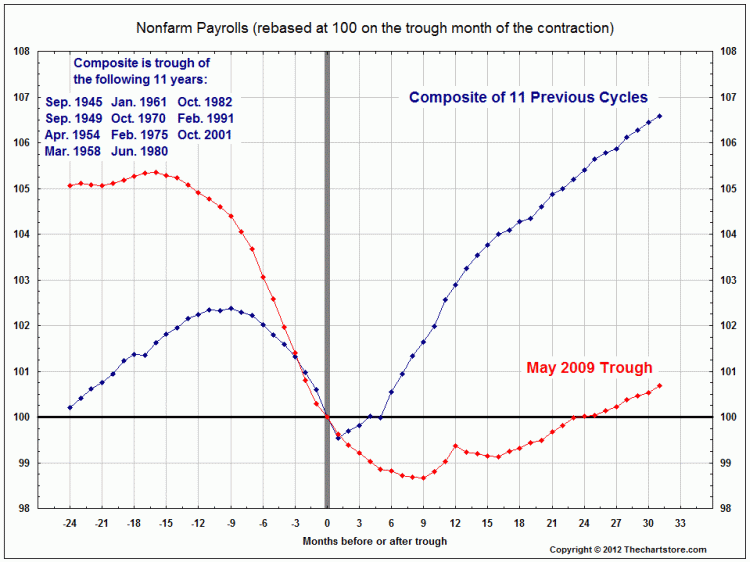
(Chart courtesy of "The Big Picture " blog (Ritholtz); originally from thechartstore.com)

The chart below shows that the recovery from this Great Recession as measured in jobs is considerably slower than the composite of all periods since WWII. Why is this?

My reading and observation convinces me that we are in a period of what I'll call rapid digital productivity (RDP).

We have been through massive technological change in the past, e.g., from manual labor to steam, the Industrial Revolution, and electrification where job dislocation occurred. Employment rebounded because the average Jane and Joe could learn new skills relatively quickly and adapt to the requirements of a new work environment and different industries. Training and apprenticeships enabled most people to cope so that they became employable and could earn a decent wage in these new or expanded industries.

More recently in the 20th Century, institutions such as public education, government, private sector, and union training programs helped people learn new skills and find new jobs in basically the same economy that existed in the former 'good times.'

I believe this era in the 21st Century is different. As digital technologies, massive networks of information, quantum leaps in software capability, miniaturization, robotics and other advances in digital/computer technology (RDP) pervade more industries, the actual work available that requires humans to perform is shrinking. Businesses are finding that they can easily substitute capital investment in these RDP technologies for labor. The inputs required for the same or increased output have become far less labor intensive. That means fewer jobs while growth, albeit more slowly, occurs.

I think we are in the midst of a massive transformation that will continue to reduce the need for labor to produce the goods and services that we need to live reasonably well. Machines and systems will continue to eliminate labor as the RDP technologies are more broadly deployed. Thus, the recovery and growth in the economy to create jobs will be far slower than promised by politicians of all stripes.

Many simply do not understand the radical transformation underway. They may believe that we will return to the 'old days' when jobs came back when a  recession ended. Some leaders prefer to talk about the hollowing-out of the middle class and blame the 'rich' as the problem, seeking a redistribution of wealth as a panacea. The problem is far deeper than that polarizing rhetoric and the solutions exceedingly more difficult than simply changing Presidents or members of Congress.

What has worked historically such as government stimulus and deficit spending may have a short term positive impact by pumping money into the economy. Demand for goods and services and some job growth may result, but this will not suffice for the long term because of the radical nature of the RDP technological transformation underway.

Instead, we need a basic re-thinking of the nature of work and the institutions that provide people the skills and resources to work productively in an economy that has declining need for the traditional skills of middle-class people. The inertia of our institutions far exceeds the increasing momentum of technological change.


A recent (January 2012) analysis of jobs and income in Vermont by the Public Assets Institute fails to even allude to the effects of technology (RDP) in the hollowing out of the middle class in the past decade or two, preferring to resort to political and policy reasons. This leads me to believe that many simply do not understand the deep effect that technology has had on the nature of work and middle class jobs in America.

January 5, 2012

Internet Access Is Not a Human Right - NYTimes.com

Mr. Cerf is absolutely correct in his view about the Internet. It is certainly not a human right, and arguably not a civil right, important as it is to our personal and social well-being.

The same rationale applies to health care. Despite the recent campaign here in Vermont by the The Workers Center, health care is not a human right. Unfortunately too many Vermont legislators believe that false rhetoric and now we are on a deliberate path toward single-payer socialized medicine, mostly on a wing and a prayer.

"Improving the Internet is just one means, albeit an important one, by which to improve the human condition. It must be done with an appreciation for the civil and human rights that deserve protection — without pretending that access itself is such a right."

December 21, 2011

Tribe Believes that SOPA Violates the First Amendment

I haven't been following the ins and outs of the proposed SOPA legislation, but I hope to read this respected legal opinion when times are quieter. Tribe Legis Memo on SOPA 12-6-11 1

November 15, 2011

Search can't scale without social, and Bing has Facebook and Twitter on its side | TechRepublic

The massive amount of information that humankind creates is becoming evermore difficult for search engines to master. This story examines what Bing and Google are up to to.
" throughout all of human history up until 2003 we created 5 exabytes of data (five billion gigabytes). We now create that much every day. In 2011, we’ll create 1.8 zettabytes of data (a zettabyte is a 1000 exabytes). That’s up from 1.2 zettabytes in 2010, and we’ll be creating over 20 times that by 2020."

'via Blog this'

November 10, 2011

Taking Aim at Internet Rules - NYTimes.com

The New York Times supports more regulation of the Internet pathways that are provided by private companies. Thankfully, they are not owned by the Government. These are not monopolies and the heavy hand of regulation is not needed. The term  'telecommunications services' that they argue includes the Internet is an artifact of a bygone age when voice communications were essentially a monopoly, thus needed regulation.
To bring back this anachronism and support regulation of the Internet is an unnecessary impediment. Should I be surprised given that the NY Times essentially has become a mouthpiece for TeamObama?
 "The Republican approach goes back to 2002, when the F.C.C., under the Bush administration, made the bizarre decision that broadband Internet communications were not, in fact, telecommunication services under the law. Last year, the F.C.C. had the opportunity to redefine broadband as a telecommunications service, which would allow greater regulatory oversight. Regrettably, it chose not to, and instead passed a limited set of rules that did not ban the practice of paying to move content faster and largely exempted wireless broadband services."

'via Blog this'

October 17, 2011

Default Choices Are Hard to Resist, Online or Not - NYTimes.com

I use both the Chrome and Internet Explorer browsers. Just for the hell of it, I set Google as the default search engine on IE and Bing as the default on Chrome. I find both are excellent.


I guess it's just not in my psyche to be defaulted.


I wonder if there's a correlation for those that accept the 'system' defaults and not voting in elections?

"...Most economists agree that Google’s default deals aren’t anticompetitive. Rivals like Bing, the general search engine from Microsoft, and partial competitors like Yelp, an online review and listing service for local businesses, have their own Web sites and other paths of distribution. Choice, in theory, is one click away.

But most people, of course, never make that single click. Defaults win..."


'via Blog this'

October 5, 2011

Apple's iCloud Ups the Ante With Amazon

Apple's iCloud Ups the Ante with Amazon


The race is on for control of consumers' digital media content purchases, storage and access. Amazon and Apple seem to be in the lead but so far Apple certainly has captured the the public's imagination and momentum with its iPhones and iPads.

Meanwhile, Amazon's recent launch of new devices, particularly its Fire tablet along with its successful history of Kindle readers will enable growth and ease of purchasing both goods and digital content.

Nevertheless, Amazon may have a substantial advantage in that as the #1 internet retailer people using its devices will be able to easily order Amazon's other products beyond digital content. Apple does not have that diverse product line. Amazon's business model seems to me more realistic, but I cannot discount the 'gotta have' emotional attachment that Apple has created for its products and its strong profitability.

"Amazon is the Internet's No. 1 retailer by sales. The company built massive server farms to deal with data generated by its online marketplace. Technology developed for its Amazon Web Services unit, the largest renter of on-demand storage space to other companies, powers some of the Fire's capabilities. Amazon's Kindle e-readers gave it a foothold in digital media devices and e-book sales.


Meanwhile, the popularity of Apple's consumer gadgets guarantees that content will be available for them. The company said Tuesday it has sold more than 250 million devices running its wireless operating system; meanwhile, its iTunes Store is the world's largest music retailer. Apple also has built its own huge server farm in North Carolina."

September 24, 2011

More Trouble for Groupon IPO: Groupon Restates Revenue, COO Exits - WSJ.com

This announcement should alert investors to be very wary should Groupon initiate an IPO. Was this high flying company cooking the books?

"On Friday, Groupon said it would change what it books as revenue after discussions with the Securities and Exchange Commission. It will now only count as revenue its commission on sales, rather than the total value of an online coupon. Previously, when it sold a restaurant gift certificate for $10, for instance, it would book the full amount, even though a portion went to the business owner.

That change reduces Groupon's stated revenue for 2010 to $312.9 million, down from the $713.4 million previously reported.

'via Blog this'

February 24, 2011

New Rules for New Technology - NYTimes.com

   I have not yet read the FCC proposal to subsidize broadband deployment in hard-to-serve areas, but the policy shift to use revised rules of the Universal Service Fund to support broadband deployment makes sense in today's technology environment.
   This will not be an easy approval process because of the very high cost areas of the country often served by small companies. These companies are heavily reliant on the transfer of funds to remain viable in today's environment. Some accommodation will be required to keep them in business and/or to continue POTS service to these costly customers.
   But broadband is the service that must be promoted for people to access the Internet and all the benefits it brings.

"The proposal from the Federal Communications Commission to stop subsidizing rural phone lines and start subsidizing rural broadband connections is long overdue. Right now an estimated 14 million to 28 million Americans have no way of getting access to the Internet."

October 11, 2010

Web Upgrade HTML 5 May Weaken Privacy - NYTimes.com

Web Upgrade HTML 5 May Weaken Privacy - NYTimes.com:


The cycle is never ending. New technology promises greater user convenience and capabilities. While we have an advertising model supporting the 'information wants to be free' expectation of the Internet, that convenience comes with a privacy price.

Please, gurus and privacy wonks, get this as right as you can. I certainly don't want government regulation of this domain. That will be worse than the abuses we may complain about.

"In the next few years, a powerful new suite of capabilities will become available to Web developers that could give marketers and advertisers access to many more details about computer users’ online activities. Nearly everyone who uses the Internet will face the privacy risks that come with those capabilities, which are an integral part of the Web language that will soon power the Internet: HTML 5."

August 14, 2010

Official Google Blog: Facts about our network neutrality policy proposal

Official Google Blog: Facts about our network neutrality policy proposal

After much opposition form many quarters, including the NY Times, Google defends it's agreement of principles with Verizon to move the 'net neutrality ' discussion forward. Wireless is where net neutrality and regulators should remain hands off for now. Limited spectrum, explosive growth, fierce competition and rapidly changing technology all favor very limited involvement by regulators.

The large question is how does net neutrality play out on the international stage? America has long been the innovator with Internet development. We should do nothing to impede that.int

August 13, 2010

Pew Research - 21 % of Americans Don't Use Internet

Twenty-one percent of Americans do not use the Internet. We live in an 80/20 world in so many ways. Yet, over time Internet usage will rival POTS household penetration (mid/upper 90 % range). Soon, too, I think.

 TechCrunch states:

"...This isn’t just people who do not use broadband (which is 66 percent of American adults). It also includes people who don’t use dial-up (another 5 percent). These people don’t use the Internet at all. That is like not using the telephone.
The number is a bit inflated because a third (34 percent) of these self-described non-users live in a house with Internet access or have family members who use the Internet regularly. They just don’t think the information on the Internet is relevant to their lives (48 percent), are uncomfortable with computers (60 percent), and are not interested in getting online (90 percent)."