Showing posts with label Europe. Show all posts

October 14, 2013

European utilities: How to lose half a trillion euros | The Economist

A fascinating story about the combined effects of government policy and renewable electricity technology in Europe. Good intentions and massive subsidies have produced very high electricity consumer prices and decimated the finances of the electric utilities. The future seems even more uncertain as the consequences of these policies are destroying wealth with no demonstrable environmental benefit.

Are the same consequences in store for America?

European utilities: How to lose half a trillion euros | The Economist: "Those goals are now harder to achieve. Renewable energy has grabbed a growing share of the market, pushed wholesale prices down and succeeded in its goal of driving down the price of new technologies. But the subsidy cost also has been large, the environmental gains non-existent so far and the damage done to today’s utilities much greater than expected. Europe in general and Germany in particular see themselves as pioneers of low-carbon energy. If they are genuinely to be so, they will need to design a much better electricity system that rewards low-carbon energy without reducing reliability and imposing undue and unnecessary costs."

'via Blog this'

April 1, 2012

Spain Now at the Top of the European Crisis Heap

[Hat tip to John Mauldin for sharing this letter in his newsletter from a banker/financier friend after a conference of high level folks in Paris.]

All signs point to continuing crisis in the Eurozone with Spain currently at the top of the heap of pain with massive unemployment and a huge housing bubble, worse than ours. John Mauldin examines it in detail in this week's newsletter.

The United States should be learning a lesson form all this, but TeamObama and the Democrats are placing re-election politics far ahead of fiscal responsibility.  Only the Ryan budget makes any sense to begin to fix the mess and keep America from descending into the 'more debt than we can afford' syndrome that plagues Southern Europe.

The United States must reform its entitlements and tax code to encourage fiscal responsibility and continue to grow the economy. No Democrat-sponsored budget plan does that. This is the drum that the Republicans should beat all the way to November.

Back from ParisDavid Kotok
We are back from Paris. The head is filled with new info. For the publicly available portion of the conference, see the GIC website, www.interdependence.org. The remaining comments will be my personal “takeaways” from both public and private conversations. By Chatham House Rule and Jackson Hole Rule, these words are attributable only to me. All errors are mine.
1. In my view, the situation in Portugal is unraveling. This may be the second shoe to drop in the European sovereign debt saga. Now that Greece has paved the way, the speed of unwind with Portugal may be much faster. I do not believe the markets are prepared for that. Runs are affecting Portuguese banks. Euro deposits are shifting to other, safer countries and the banks that are in those countries. Germany (German banks) is the largest recipient. Remember, deposits in European banks are guaranteed by the national central banks and the national governments, not the ECB. There is no FDIC to insure deposits in the Eurozone.
2. The issue is that Greece was supposed to be “ring-fenced.” Notice how European leaders have stopped using that word. Their new word is firewall. If a second country (Portugal) restructures, the sovereign debt issues become systemic rather than idiosyncratic. That becomes the second game-changer. Systemic risk needs big firewalls. We learned that the hard way with Lehman and AIG, which were systemic, vs. Countrywide and Bear Stearns, which were “ring-fenced” – or thought to be ring-fenced at the time.
3. A game-changer was the use (not threat) of the collective action clause by Greece. CAC altered the positions of the private sector. It rewrote a contract after the fact. That is why Portugal’s credit spreads are wide: the private-sector holders of Portuguese debt know that a CAC can be used on them, too. The same is true for all European sovereign debt. A re-pricing of this CAC risk is underway.
4. Private holders of Greek debt had several years to get out before the eventual failure. Those that did not get out were crushed in the settlement. Greece is now a ward of governmental and global institutions like the ECB, IMF, and others. It is unlikely to have market access for years. This is another game-changer. In the old crisis days, the strategy was to regain market access quickly and restore private-sector involvement. In the new Eurozone-CAC crisis days, the concept is to crush the private-sector holders, and that means no market access for a long time. Instead, we will have ongoing and increasing sunk costs by governmental institutions. Caveat: government does not know how to cut losses and run. Government only knows how to run up small losses until they are huge. Witness Fannie Mae in the US. Witness the sequence that allowed Greece to fester for years. Government does not know how to take the “first loss,” which is usually the smallest lost. Government does know how to run up moral hazard.
5. The term moral hazard means the action is done today and the price is determined later, after the chickens come home to roost and crap all over the coop. That is the nature of government everywhere. By the time the chickens return, the political leaders have changed. Those who took the moral hazard risk are gone. Those who inherited their mess are blamed during the cleanup. That is where we are today in Europe. Hence, the political risk is rising daily. Elections could change these governments, and the new governments may repudiate the actions of the old ones. We expect more strikes and unrest. That is how elections can be influenced.
6. European debt-crisis issues are lessons for the US. They belong in the political debate. Both political parties are responsible for our growing debt issues. Bush ran up huge deficits. Obama continued them. Each party blames the other. Neither takes on the responsibility of their actions. We shall see how this evolves between now and November.
I am more pessimistic about peripheral Europe than I have been. All that my co-author Vincenzo Sciarretta and I wrote in our book several years ago is now being reversed by policies. In the beginning, the Eurozone benefited immensely from economic integration and interest-rate convergence. Now it faces disintegration and divergence. Reverse the chapters in the book and play the film backwards.
Can Europe find a stabilizing level and resume growth? Time will tell. Meanwhile, political leaders and central bankers are going to be tested again.
This ain’t over. Yogi is correct.

December 4, 2011

The Eurozone 's Stark Choices

Below is an excerpt from writings of John Mauldin, <FrontlineThoughts.com> a financial analyst which sums up the choices facing the EuroZone. December 9 is shaping up as a very big day for Europe and world financial markets.

"...Merkel and Sarkozy have told us they will meet Monday and announce a plan on December 9, when the full eurozone meets. Forget bazookas, this needs the equivalent of a howitzer. They are seemingly intent upon rewriting the treaty, which is the only way that the Germans will go along with any major ECB action. But by my reckoning, a few hundred billion, or even a trillion, is not major action, at least not on the level of what will be needed.
The price for German acquiescence will be a loss of sovereignty and the ability to run deficits of any real size for any appreciable length of time for the countries of Europe. Will the peripheral countries go along? Heck, forget them; will Finland go along? This situation has been coming along since the foundation of the eurozone. The early founders acknowledged that a tighter fiscal union would eventually be necessary if the euro experiment were to survive. And eventually is now. As in this month. Time is running out if they want to forestall a credit crisis that would be worse than 2008.
The world is watching, as what happens in Europe will affect us all, in every part of the globe. It could easily tip the US into recession, and it will only be worse for the emerging markets. For Europe, the Endgame is now. We can only hope they come up with a plan that avoids disorderly defaults and a crisis far graver than 2008. They have no good choices, only difficult ones and disastrous ones. Let us hope they choose wisely.
(And for my fellow Americans, note that we will face the same consequences if we do not get our own house in order, and very soon. This is more than an academic observation.)" [emphasis added]

November 26, 2011

Banks Build Contingencies for Euro Zone Breakup - NYTimes.com

Markets rule, not Governments!
 "On Friday, Standard & Poor’s downgraded Belgium’s credit standing to AA from AA+, saying it might not be able to cut its towering debt load any time soon. Ratings agencies this week cautioned that France could lose its AAA rating if the crisis grew. On Thursday, agencies lowered the ratings of Portugal and Hungary to junk.
While European leaders still say there is no need to draw up a Plan B, some of the world’s biggest banks, and their supervisors, are doing just that."

'via Blog this'

November 11, 2011

European economies: Europe's deepening crisis | The Economist

European economies: Europe's deepening crisis | The Economist:

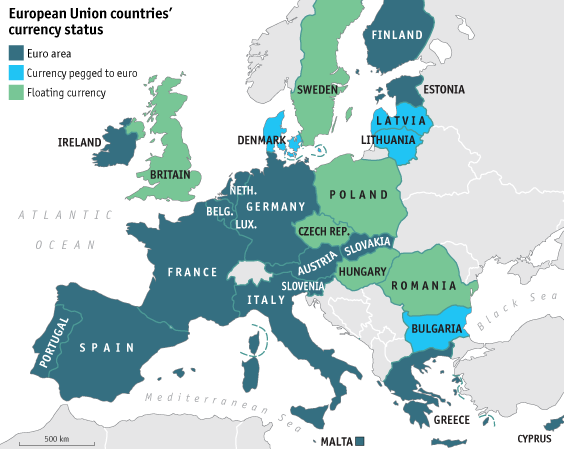
Contains a map of Europe including the Euro zone and how other countries' currencies are connected ...or not. Norway, Switzerland and Great Britain seem less affected.

'via Blog this'

February 10, 2008

Gates Says NATO at Stake In Afghan Mission Debate - WSJ.com

Gates Says NATO at Stake In Afghan Mission Debate - WSJ.com

The U.S. cannot be 'alone' in fighting terrorism in Afghanistan and elsewhere. NATO had best step up to its obligations to do its part. I wonder if Senators Clinton and Obama have a plan to provide for our common defense?

MUNICH, Germany -- Survival of the North Atlantic Treaty
Organization alliance, a cornerstone of U.S. security policy for six decades, is at stake in the debate over how the U.S. and Europe should share the burden of fighting Islamic extremism in Afghanistan, U.S. Defense Secretary Robert Gates
said Sunday.

"We must not -- we cannot -- become a two-tiered alliance of
those willing to fight and those who are not," Mr. Gates told the Munich Conference on Security Policy, where Afghanistan was a central topic. "Such a development, with all its implications for collective security, would effectively destroy the alliance."

[Robert Gates]

Washington has had innumerable disputes with its NATO allies in the 59 years since the alliance was founded as a bulwark against the former
Soviet Union. But today's debate over the importance of the mission in Afghanistan and how to accomplish it was portrayed by Mr. Gates as among the most difficult ever.

A central theme of Mr. Gates's speech was his assertion that al Qaeda extremists, either in Afghanistan or elsewhere, pose a greater threat to Europe than many Europeans realize.

After delivering his prepared remarks Mr. Gates fielded questions from his audience, which included dozens of top government officials, mainly from Europe and the U.S., as well as military officers, private security specialists, members of Congress and European parliamentarians.

November 21, 2007

BBC NEWS | Europe | French trains 'hit by sabotage'

Sarkozy is right to see his reforms through to the end, even in the face of sabotage, which is typical of strikes against 'big' companies and especially utilities. Socialism is a system that should be avoided wherever possible. France's present leadership sees a way to France's better future, but it will not come easily after so many decades of a paternalistic socialist regime that creates lower and middle class 'wards of the state.'

Below is the 'Special' pensions system that Sarkozy vows to change, and none too soon.

'SPECIAL' PENSIONS SYSTEM

Benefits 1.6m workers, including 1.1m retirees

Applies in 16 sectors, of which rail and utilities employees make up 360,000 people

Account for 6% of total state pension payments

Shortfall costs state 5bn euros (£3.5bn; $6.9bn) a year

Some workers can retire on full pensions aged 50

Awarded to Paris Opera House workers in 1698 by Louis XIV

BBC NEWS | Europe | French trains 'hit by sabotage'

September 20, 2007

The French Revolution - New York Times

The French Revolution - New York Times

Cohen's piece exposes the hypocrisy that is/was France and shows that President Nicolas Sarkozy is a leader largely unencumbered with the barnacles of French Socialism and haughty attitudes. I have not been a fan of France or French attitudes since DeGaulle kicked out American military bases in 1966 when he withdrew from NATO. I was in the Army in Germany at the time and we received a huge influx of supplies to store.

Perhaps Sarkozy has a chance to get the country back on track as a useful ally in Western civilization rather than mired in the patronizing muck of their own pride and wrong-headed Socialism. Perhaps more Frenchmen will be come productive workers rather than expecting government handouts.

I might even consider buying French wine again, despite its inflated reputation.

September 10, 2007

Sea change | Economist.com

Sea change | Economist.com

A fascinating review of the technology changes and cost savings that are underway in the North Sea oil and gas fields. While today's pop culture of energy is focused on conservation and climate change from energy usage, we should be thankful that we have bright people hard at work in 'big oil' keeping the oil and gas flowing and doing all they can to control the costs of doing it.

This work is essential to keep our Western economies humming.

March 26, 2007

Prague - A Gem of a City

We have friends in Prague, former refugees who came to America while the Berlin Wall and the Soviet Union were still around, and we hope to visit them this year or next.

"ITALIANS IN BOHEMIA
You may not expect a Slavic capital to be a font of Italian culture, but Prague has been the home to notable Italians ever since the 16th-century court of Rudolph II employed the painter Giuseppe Arcimboldo, the gem-cutter Ottavio Miseroni and the sculptor Alessandro Abondio. Today the
art
is culinary. Check out Vino di Vino (Vezenska 3, 420-222-312-999;
www.vinodivino.cz), a wine bar in Old Town that recently added a small selection of recipes from the Piedmont region. Entrees cost 360 to 580 koruny, or about $16.50 to $27 at 21.8 koruny to the dollar. For truly outstanding Italian cooking in Prague — and many would say anywhere this side of the Alps — head to Allegro inside the Four Seasons Hotel (Veleslavinova 2a, 420-221-427-000, www.fourseasons.com/prague). The chef Vito Mollica serves seasonal dishes like slow-roasted veal with Alba truffles and aged Modena balsamic vinegar, with entrees costing 640 to 1,700 koruny. You can see why some Italians think twice before leaving Prague for home."


I didn't know about the Italian connection, but our friend escaped tp Italy before coming to the U.S. as a political refugee.