Showing posts with label economy. Show all posts

January 18, 2014

The future of jobs: The onrushing wave | The Economist

The future of jobs: The onrushing wave | The Economist:

We are in for a long , difficult economic and societal dilemma as spelled out in this piece. The political expression of it is the growing gap between the rich and the poor and the hollowing out of the middle class that politicians bloviate about without offering any real solutions. Perhaps they fail to understand or believe the underlying problem, opting instead to try and legislate job growth..

I'm reading this book, The Second Machine Age: Work, Progress, and Prosperity in a Time of Brilliant Technologies,  referenced in the Economist story, which provides deep insight about the disruption of the traditional economic expectations.

"In a forthcoming book Thomas Piketty, an economist at the Paris School of Economics, argues along similar lines that America may be pioneering a hyper-unequal economic model in which a top 1% of capital-owners and “supermanagers” grab a growing share of national income and accumulate an increasing concentration of national wealth. The rise of the middle-class—a 20th-century innovation—was a hugely important political and social development across the world. The squeezing out of that class could generate a more antagonistic, unstable and potentially dangerous politics.
The potential for dramatic change is clear. A future of widespread technological unemployment is harder for many to accept. Every great period of innovation has produced its share of labour-market doomsayers, but technological progress has never previously failed to generate new employment opportunities."
I believe it's different this time because of the blinding pace of technological change and the ability to explore new models of productivity, work and service, nearly all of which reduce the human labor content in many previously 'safe' occupations.

Our institutions are more deeply entrenched and harder to change. Poorly educated people do not stand a chance for their insufficient skills to command a good-paying job in this new economy. With more generous government benefits, the incentive to work disappears from most folks.

'via Blog this'

September 3, 2013

Not Really Labor's Day - NYTimes.com

Not Really Labor's Day - NYTimes.com: "The lack of any fiscal stimulus aimed at lowering unemployment has contributed to this trend. Ironically, the Federal Reserve’s policy of quantitative easing to stimulate the economy and lower unemployment – which some Republicans tried unsuccessfully to outlaw — has probably also benefited those at the top more than those at the bottom. Lower interest rates have driven up the price of stocks, but left those dependent on less risky sources of investment income (such as savings accounts and bonds) stranded with low returns."

+++++++++++++++++++++++++++++++++++
Accelerated adoption of digital technology (reduction in the labor component) and globalization (lower priced labor component) on the classical economic definition of productivity has favored capital investment and its returns. These megatrends have disrupted the expectations and requirements for workers.

This is why I believe the historic Keynesian economic theory that government 'stimulus' will goose the economy no longer works as it has in the past.

The Fed's stimulus efforts (low interest rates, QE, etc.) have fallen short of expectations and have benefited capitalists far more than labor because of the two mega-factors mentioned above.

Add to these difficulties the inertia of the education system and we have a dispirited workforce ill-prepared for today's and tomorrow's economy.

June 25, 2013

How Technology Is Destroying Jobs | MIT Technology Review

How Technology Is Destroying Jobs | MIT Technology Review: "­Brynjolfsson, a professor at the MIT Sloan School of Management, and his collaborator and coauthor Andrew McAfee have been arguing for the last year and a half that impressive advances in computer technology—from improved industrial robotics to automated translation services—are largely behind the sluggish employment growth of the last 10 to 15 years."

I read Brynjolfsson and McAfee's book in 2011 and remain persuaded they are correct in their analysis. This piece in the MIT Technology Review is highly recommended reading and, of course, the hundreds of comments following in are equally insightful. Read the book if you have the inclination.

I am also convinced that nearly all our policy-makers and politicians are clueless about what to do about the job dislocations in the short term. Meanwhile, government policies are driven not by reality, but by perceived political power and gains. Traditional thinking that the Great Recession will end and things will improve for the U.S. based on past history is likely wrong, particularly so Keynesian economics which drives so much government policy and spending which does not produce the same results as previously. The fundamentals have changed.

Some experts argue (Harvard economist Lawrence Katz in this piece argues that this technological upheaval of the past two decades is merely part of a long term trend that began with the Industrial Revolution.) this is just a continuation of the technological progress of mankind

I think we are in a period of profound change driven primarily by advances in software and extremely capable and fast hardware that can mine and capture the value of 'Big Data.' The combination of technologies is creating capacity and capabilities that supplant the need for more and more human labor to produce goods and services that drive the economy.
"W. Brian Arthur, a visiting researcher at the Xerox Palo Alto Research Center’s intelligence systems lab and a former economics professor at Stanford University, calls it the “autonomous economy.” It’s far more subtle than the idea of robots and automation doing human jobs, he says: it involves “digital processes talking to other digital processes and creating new processes,” enabling us to do many things with fewer people and making yet other human jobs obsolete."
The wild card of course is that the negative effects of technology on jobs is seen mostly in advanced economies and less so in the underdeveloped world where manual processes prevail. The big question is will these countries and peoples grab the advantages of these advances in technology and raise their living standards or will religious, ethnic and cultural factors retard economic gains and better living conditions?

From the Story:

WHY IT MATTERS

Economic theory and government policy will have to be rethought if technology is indeed destroying jobs faster than it is creating new ones.

June 21, 2013

Our Broken Social Contract - NYTimes.com

Mr. Edsall aptly captures the arguments that underlie the talking points of today's political class.

Unfortunately, we have no consensus about how to resolve this looming crisis principally because we have no agreement on the root causes.  It's in neither political party's interest to solve the problem because they would lose leverage and power by agreement on the factors that are driving the decline in values, income and the common good.

We have become mired in the narcissistic "What's in it for me?" approach to life and unwilling to embrace the 'common good,' assuming we could agree on what that is in today's world.

At bottom, we have the lost the 'glue' that binds a healthy society together.

Our Broken Social Contract - NYTimes.com:
"If these trends continue, and most evidence suggests they will, one of the central ironies of the Obama years will be that a Democratic administration committed to pushing back against the unjust distribution of resources and to the promotion of morally cohesive communities will in fact have overseen an eight-year period of social disintegration, inequality and rising self-preoccupation."

I strongly recommend reading the commentary by David Brooks, The Solitary Leaker, in the New York Times dated June 10, 2013. Brooks provides thoughtful insights into why Snowden acted as he did and the deeper societal problems spotlighted by his actions.


January 20, 2013

The Smartphone Have-Nots - NYTimes.com

A reasoned piece about the two main theories to explain the increase in income inequality during the last couple of decades. I firmly believe that technology is at the heart of this phenomenon because the information technology revolution has empowered high skilled and highly motivated individuals to grab this golden ring.

Meanwhile, others with less intellectual capacity, motivation, skills, unwillingness to move, or inability to pay for educating themselves have not been able to keep up resulting in lower paying jobs.
Another factor at work is the super-rich have leveraged their higher incomes into investment portfolios that have resulted in substantial income from capital gains, dividends, etc, which are taxed at a lower rate.

Income inequality is not inherently evil unless it results in repression. Nevertheless, the democracy is at risk and politicians will continue to fight over its causes and remedies.


The Smartphone Have-Nots - NYTimes.com:

 "....After Mishel finished his presentation, David Autor, one of the country’s most celebrated labor economists, took the stage, fumbled for his own PowerPoint presentation and then explained that there was plenty of evidence showing that technological change explained a great deal about the rise of income inequality. Computers, Autor says, are fundamentally different. Conveyor belts and massive steel furnaces made blue-collar workers comparatively wealthier and hurt more highly skilled crafts­people, like blacksmiths and master carpenters, whose talents were disrupted by mass production. The computer revolution, however, displaced millions of workers from clerical and production occupations, forcing them to compete in lower-paying jobs in the retail, fast-food and home health sectors. Meanwhile, computers and the Internet disproportionately helped people like doctors, engineers and bankers in information-intensive jobs. [emphasis added] Inequality was merely a side effect of the digital revolution, Autor said; it didn’t begin and end in Washington......"

'via Blog this'

December 26, 2012

Thomas Sowell: Fiscal Cliff Notes (Part II) — Frontiers of Freedom

Part II of Thomas Sowell's rational analysis on the political charade that dominates Washington these days. The nation has a spending problem, not a revenue problem, a fact that the media fails to fully examine. Instead, they buy the Democrat political spin.

Thomas Sowell: Fiscal Cliff Notes (Part II) — Frontiers of Freedom: "The bottom line is that Barack Obama’s blaming increased budget deficits on the Bush tax cuts is demonstrably false. What caused the decreasing budget deficits after the Bush tax cuts to suddenly reverse and start increasing was the mortgage crisis. The deficit increased in 2008, followed by a huge increase in 2009.
So it is sheer hogwash that “tax cuts for the rich” caused the government to lose tax revenues. The government gained tax revenues, not lost them. Moreover, “the rich” paid a larger amount of taxes, and a larger share of all taxes, after the tax rates were cut.
That is because people change their economic behavior when tax rates are changed, contrary to what the Congressional Budget Office and others seem to assume, and this can stimulate the economy more than a government “stimulus” has done under either Bush or Obama."

http://townhall.com/columnists/thomassowell/2012/12/05/creators_oped

Washington Times, Thomas Sowell: Fiscal Cliff Notes (Part I), 12/4/12

Thomas Sowell is right about politics dominating any serious discussion publicly about the trillion dollar deficits and mounting debt from TeamObama. The hand-wringing about recession and the fiscal cliff is steeped in politics and not serious negotiations to right the nation's fiscal ship.

Washington Times, Thomas Sowell: Fiscal Cliff Notes (Part I), 12/4/12“All the political angst and moral melodrama about getting ‘the rich’ to pay ‘their fair share’ is part of a big charade. This is not about economics, it is about politics. Taxing ‘the rich’ will produce a drop in the bucket when compared to the staggering and unprecedented deficits of the Obama administration.”"

'via Blog this'

October 30, 2012

The Unemployment Rate is Not the Best Measure of the Economy or a President

A friend sent me and many others this email :
"To: anyone who will listen.....
Since I've been trying to pay attention to the spin by both sides as we approach Nov. 6, (I've already voted, btw---for Obama), I went to the website of the Bureau of Labor Statistics, and found the following eye-opening chart. It clearly shows the decline in the unemployment rate during the Bush years, then the precipitous climb (a loss of 2.5 million jobs) during his last year in office. The trend continued when Obama took over the mess, and, since '09, a steady, gradual decline in UNEMPLOYMENT.
What I'd like to know is why this clear picture isn't being plastered ALL OVER for everyone to see......let's get going!!!!!"
Accompanied by this chart :
My response to her (Using BLS data):

The unemployment rate and the way it is determined tells only part of the economic story and is relied on far too heavily by the sound-bite media.

The reality is that in August 2012, we had about the same non-farm payroll (133,244,000) as we did in January of 2005 (132,453,000). In Jan 2008 it was 138,023,000.
In January 2009 it was 133,561,000. Meanwhile, the population has grown from 295,753,000 to 314,159,000 or 18,406,000 since January 2005. So, Obama spin claims to have created 5 million jobs, yet the number of people working has not increased since he took office.

This also means that the number of working Americans is essentially the same as it was 7 years ago while the population has increased by 6.2%.

Meanwhile the median household income (inflation adjusted) looks like this:
2005 $53,371
2008 $52,546
2011 $50,054
Change = -6.2%

So, looking at the economy from the data about workers and population and household income, shows a very weak economic recovery, one that does not provide sufficient good paying jobs for our people, many of whom have dropped out of the workforce and/or stopped looking for work These people are not included in the unemployment rate determination. Some estimate the true unemployment rate to be closer to 11-12%.

I’d love to talk more about this with you, but Obama’s positive contribution to the economic ‘recovery,’ such as it is, is de minimus, despite he and the Congress increasing the debt by ~ 6 $Trillion to stimulate it.

All spin aside, the media and we give far too much credence to the power of a President over the economy. Congress is the real player, albeit heavily influenced by the President, when it comes to fiscal and economic policy and their record is dismal. For example, the Senate has not passed a budget in more than three years.

Romney’s approach makes more sense to me than another 4 years of Obama.

October 24, 2012

Race for President Leaves Income Slump in Shadows - NYTimes.com

Race for President Leaves Income Slump in Shadows - NYTimes.com: "Many of the bedrock assumptions of American culture — about work, progress, fairness and optimism — are being shaken as successive generations worry about the prospect of declining living standards. No question, perhaps, is more central to the country’s global standing than whether the economy will perform better on that score in the future than it has in the recent past."

Some well-reasoned analysis in this piece, most of which I agree with. In the 'silly season' before elections politicians often deal with 'froth' in their campaigns because the underlying forces driving our fiscal mess and poor performing economy cannot be dealt with in a sound bite or 30 second ad.

The fundamental issue in the Presidential campaign is whether the government is the best solver of our economic and fiscal problems of whether the role of the private sector can best do it. I favor the private sector and I think more and more voters are coming around to that viewpoint because they see the trillion dollar deficits of TeamObama have produced poor results and unsustainable debt but little economic improvement.
Missing from the story is the corrosive effect of entitlements on America's fiscal health. Entitlements persuade people who have them not to lose them and to vote accordingly. (Entitlements do little to grow the economy except provide a source of consumer spending.) Politicians know this and too many pander to the recipients for their votes.

The fundamental problems in our economy have no quick fix, yet that's what too many voters unrealistically expect and that politicians over-promise with their 'make sure...' rhetoric.

The only way to improve incomes is to grow the pie (the economy) not redistribute it. Even if all the income of the super-rich was confiscated and applied to the deficits it would be a drop in the bucket.
It boils down to this: Which Presidential candidate and Congresspersons do voters trust to best set a course to solve the problems we face. Romney's proposals ring truer than Obama's.

'via Blog this'

August 11, 2012

The November Election is A Clear Choice of Worldviews

Mitt Romney's choice of Paul Ryan as his running mate sharpens the focus in the November elections between competing views of America's future. Obama, Biden and a Democrat Senate vs. Romney, Ryan and a Republican House.

The Democrat view comprises more spending, unsustainable debt and costly entitlements without a fiscal reform plan in association with a Senate that has failed to pass a budget in more than three years.

TeamRomney promises economic reform, job growth, fiscal responsibility,entitlement restraint repeal of ObamaCare and a return more limited government.

While all campaigns are full of promises, I favor TeamRomney as charting a better course for our country. TeamObama has no record of success in creating a better future for our nation.

Most important in this election is to populate Congress with Senators and Representatives that will create a future that is affordable and sustainable. The present dysfuntional Congress has failed its citizens


News Alertfrom The Wall Street Journal

Mitt Romney picked Rep. Paul Ryan as his running mate, a decision that could spark enthusiasm for the Republican ticket among conservatives and all but ensures the election will turn to deep philosophical divisions between the two parties over spending, taxes and entitlements.
In Mr. Ryan, 42 years old, the Romney campaign gets a conservative who has spent recent years at the center of national debates about the size and scope of the federal government. With his proposals to revamp entitlement programs for future retirees and the poor, he has become a hero to conservatives and a target for liberals.
The pick was officially announced on Mr. Romney’s phone app just after 7 a.m. Mr. Romney plans to hold an event at 9 a.m. on the USS Wisconsin, which carries the name of Rep. Ryan's home state.

http://online.wsj.com/article/
SB1000087239639044340400457758
2112521141598.html?mod=djemalertNEWS

August 3, 2012

Job Growth in Private Sector

WSJ reports that July's job growth was in the private sector. That's good news. Government should continue to shrink even faster for a healthier economic rebound.

"The Labor Department Friday said private companies accounted for all of the growth in July payrolls, adding 172,000 jobs during the month. Governments, meanwhile, shed 9,000 positions. The federal work force shrank by 2,000."

June 15, 2012

Where Paul Krugman, Keynes are vulnerable - Howard Gold's No-Nonsense Investing - MarketWatch

Howard Gold Believes Krugman and Keynes are Wrong for Today's Economy.  I agree.


I believe America's unemployment is structural for a number of reasons, not the least of which is the impact of technology.


Growing the economy is complicated by the structural changes and dislocations from accelerating technological change which are ‘eating’ traditional jobs,  jobs that previously required humans, previously low-skill, low-priced humans. What’s happening now is that even higher skills are being replaced by technological efficiencies.

Already in many industries and occupations, we have seen that digital and robotic technologies have permanently displaced jobs and skills. With investments in these technologies companies can increase economic output without the corresponding labor component that was both expected and experienced experienced by workers in the past as America exited economic doldrums. The upshot is that many jobs simply will not return and the doldrums are more or less permanent.

As only one example among many, think about the implications in the not too distant future of cars and trucks that drive themselves more adroitly and safely than people can. Google and several other companies are developing such vehicles and as states allow them to to be registered and operated, we can expect more jobs to disappear.

The high skills required to service this new economy are in short supply because the education system lags behind the pace of technological change. Meanwhile, our self gratifying culture works against people desiring to be equipped to work hard to succeed. The ‘entitlement mentality’ pervades far too many lives. We see it in the growing expectations of a government that cannot afford these demands in an economy that is predicted to grow at half its historic rate into the future.


"But what if the problem isn’t only a dearth of demand? Krugman is adamant that current U.S. unemployment is not structural — i.e., that it has deeper causes such as a mismatch of skills between workers and the available jobs.
“…Structural unemployment is a fake problem, which mainly serves as an excuse for not pursuing real solutions,” he wrote. “…All the facts suggest that high unemployment in America is the result of inadequate demand — full stop.”
Actually, economists are divided on this issue — studies by the Chicago and San Francisco Fed support Krugman, while a recent International Monetary Fund paper pegged the structural contribution to long-term U.S. unemployment at 40%. That’s two million people, hardly trivial."
'via Blog this'

May 6, 2012

April 2012 Employment Information - Grim News

[Hat tip to John Mauldin/Barry Ritholz for this information quoting yet another source,  Philippa Dunne & Doug Henwood of The Liscio Report (www.theliscioreport.com)]

Jobs, the fodder for much political rhetoric in this campaign season, are not growing and we have little evidence of a sustained economic recovery.  Too many people are not in the labor force.

I believe that we are a long way from creating enough good paying jobs with a supply of people qualified to take them. Capital investments in technology will continue to substitute for labor for the foreseeable future, IMHO.

"* The longer-term picture of labor force withdrawal is kind of shocking. Total household employment is down by 4.4 million since the Great Recession began in December 2007, and the number of unemployed is up by 4.9 million. The civilian population is up 9.6 million – but the labor force is up just 447,000. The number classed as not in the labor force is up by 9.2 million – and those not in the labor force and wanting a job is up 1.7 million. In other words, just 5% of the increase in the adult population over the last 4 1/3 years has found its way into employment; the other 95% are not in the labor force.

* The unemployment rate fell by 0.1 point to 8.1%, its lowest level in more than three years. The number of unemployed fell by 173,000 – but the labor force shrank by almost the same amount, 169,000.

Without the labor force shrinkage, the unemployment rate probably would have been unchanged. Within the unemployed, the number of job losers fell – but so did the number of re-entrants and voluntary leavers, suggesting that the increased confidence we saw through those indicators in recent months may be dissipating. With the quit rate down, and the long-term unemployed dropping out of the labor force, the mid-ranges of unemployment duration (from 5-26 weeks) saw an increase, as the extreme short- and long-term durations fell."


April 22, 2012

The FED has Few Tools to Fight Inflation or Stimulate the Economy

Thanks to Steven Hansen at Seeking Alpha for this straightforward analysis of The Fed's policy and what seems a long future of near-zero interest rates. Disturbingly, the FED has few tools in the kit to control inflation or stimulate growth.
Meanwhile, Congress dithers as their unsustainable spending binge creates huge deficits and debt that will bury the country. What a sad commentary on our government and society. We need to turn this around, not for the benefit of the "1%," but for the future of the Republic.
A vote for Obama and his policies in November is a vote against the country's prosperous future and a general reduction in our standard of living.
"...Reading between the lines - the Fed is not seeing economic traction anytime soon. Consider that USA monetary policy is based on gold standard conventions which becomes less and less effective as government debt grows. Further modern day monetary policy for a major currency is effected[sic] by leakage and actions by other currencies.
The Fed cannot allow interest rates to raise when:
  • the servicing costs of government debt would strangle the economy; or,
  • if the government goes on an austerity program, which will contract the economy, and loose monetary policy must prevail to try to mitigate a shrinking economy; or,
  • the stalemate in Washington is not allowing long term solutions as the debt continues to grow. Under this circumstance, the Fed must accommodate the lack of leadership for fiscal policy.
In short, the USA is between a rock and a hard place - as it is almost certain that rising interest rates would apply abnormally large brakes on the economy. Realistically, there is little difference between 0% and 0.5%, so politically based monetary policy movements are possible.
Yet, there are too many parallels with Japan (mainly debt plus demographics) to believe the USA can escape economic doldrums without a major shift to a less of a gold standard approach to monetary policy.
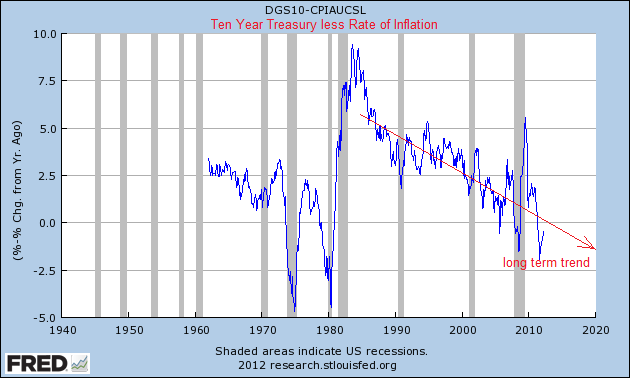
In the meantime, unless you are in the 1% - prepare for a less affluent future. In the olden days (pre-New Normal), your plan for retirement was based on less risky bonds for income and cashing out the old hacienda so that one could make lifestyle decisions. For those already retired, and the boomers - time to look for Plan B as shown on the below chart which shows real return on 10 year treasuries."
(click to enlarge)

April 1, 2012

Spain Now at the Top of the European Crisis Heap

[Hat tip to John Mauldin for sharing this letter in his newsletter from a banker/financier friend after a conference of high level folks in Paris.]

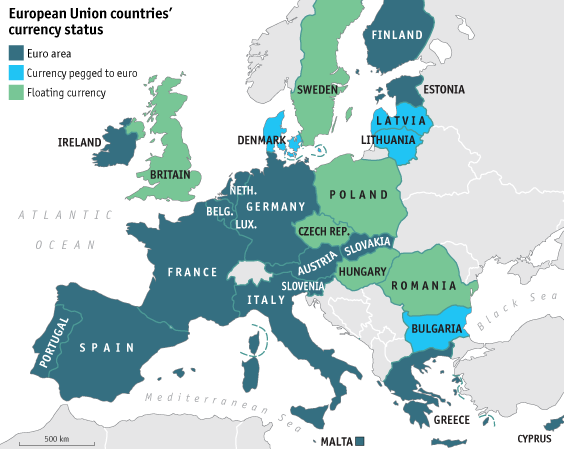
All signs point to continuing crisis in the Eurozone with Spain currently at the top of the heap of pain with massive unemployment and a huge housing bubble, worse than ours. John Mauldin examines it in detail in this week's newsletter.

The United States should be learning a lesson form all this, but TeamObama and the Democrats are placing re-election politics far ahead of fiscal responsibility.  Only the Ryan budget makes any sense to begin to fix the mess and keep America from descending into the 'more debt than we can afford' syndrome that plagues Southern Europe.

The United States must reform its entitlements and tax code to encourage fiscal responsibility and continue to grow the economy. No Democrat-sponsored budget plan does that. This is the drum that the Republicans should beat all the way to November.

Back from ParisDavid Kotok
We are back from Paris. The head is filled with new info. For the publicly available portion of the conference, see the GIC website, www.interdependence.org. The remaining comments will be my personal “takeaways” from both public and private conversations. By Chatham House Rule and Jackson Hole Rule, these words are attributable only to me. All errors are mine.
1. In my view, the situation in Portugal is unraveling. This may be the second shoe to drop in the European sovereign debt saga. Now that Greece has paved the way, the speed of unwind with Portugal may be much faster. I do not believe the markets are prepared for that. Runs are affecting Portuguese banks. Euro deposits are shifting to other, safer countries and the banks that are in those countries. Germany (German banks) is the largest recipient. Remember, deposits in European banks are guaranteed by the national central banks and the national governments, not the ECB. There is no FDIC to insure deposits in the Eurozone.
2. The issue is that Greece was supposed to be “ring-fenced.” Notice how European leaders have stopped using that word. Their new word is firewall. If a second country (Portugal) restructures, the sovereign debt issues become systemic rather than idiosyncratic. That becomes the second game-changer. Systemic risk needs big firewalls. We learned that the hard way with Lehman and AIG, which were systemic, vs. Countrywide and Bear Stearns, which were “ring-fenced” – or thought to be ring-fenced at the time.
3. A game-changer was the use (not threat) of the collective action clause by Greece. CAC altered the positions of the private sector. It rewrote a contract after the fact. That is why Portugal’s credit spreads are wide: the private-sector holders of Portuguese debt know that a CAC can be used on them, too. The same is true for all European sovereign debt. A re-pricing of this CAC risk is underway.
4. Private holders of Greek debt had several years to get out before the eventual failure. Those that did not get out were crushed in the settlement. Greece is now a ward of governmental and global institutions like the ECB, IMF, and others. It is unlikely to have market access for years. This is another game-changer. In the old crisis days, the strategy was to regain market access quickly and restore private-sector involvement. In the new Eurozone-CAC crisis days, the concept is to crush the private-sector holders, and that means no market access for a long time. Instead, we will have ongoing and increasing sunk costs by governmental institutions. Caveat: government does not know how to cut losses and run. Government only knows how to run up small losses until they are huge. Witness Fannie Mae in the US. Witness the sequence that allowed Greece to fester for years. Government does not know how to take the “first loss,” which is usually the smallest lost. Government does know how to run up moral hazard.
5. The term moral hazard means the action is done today and the price is determined later, after the chickens come home to roost and crap all over the coop. That is the nature of government everywhere. By the time the chickens return, the political leaders have changed. Those who took the moral hazard risk are gone. Those who inherited their mess are blamed during the cleanup. That is where we are today in Europe. Hence, the political risk is rising daily. Elections could change these governments, and the new governments may repudiate the actions of the old ones. We expect more strikes and unrest. That is how elections can be influenced.
6. European debt-crisis issues are lessons for the US. They belong in the political debate. Both political parties are responsible for our growing debt issues. Bush ran up huge deficits. Obama continued them. Each party blames the other. Neither takes on the responsibility of their actions. We shall see how this evolves between now and November.
I am more pessimistic about peripheral Europe than I have been. All that my co-author Vincenzo Sciarretta and I wrote in our book several years ago is now being reversed by policies. In the beginning, the Eurozone benefited immensely from economic integration and interest-rate convergence. Now it faces disintegration and divergence. Reverse the chapters in the book and play the film backwards.
Can Europe find a stabilizing level and resume growth? Time will tell. Meanwhile, political leaders and central bankers are going to be tested again.
This ain’t over. Yogi is correct.

March 12, 2012

Gas prices sink Obama’s ratings on economy; bring parity to race for White House - The Washington Post

Somewhere out there in the media cloud we'll read some speculation that high gas prices is a Republican plot from Big Oil interests designed to unseat TeamObama. Nasty speculators are obviously trying to orchestrate his defeat in this rabid election year.


Or, that Obama secretly likes high gas prices so that alternative energy zealots and environmentalists will be mollified and more subsidies can flow to the renewables industry to save the planet while more campaign contributions will flow to Obama's re-election coffers.
OTH, perhaps it's part of a normal economic cycle of supply and increasing world demand exacerbated by threats that the flow from Iran will be disrupted either by boycotts or military actions.


Ahhhh...the politics of economics, a never ending clash of campaign reality with the dismal science and fodder for pundits.
"Disapproval of President Obama’s handling of the economy is heading higher — alongside gasoline prices — as a record number of Americans now give the president “strongly” negative reviews on the 2012 presidential campaign’s most important issue, according to a new Washington Post-ABC News poll.
Increasingly pessimistic views of Obama’s performance on the economy — and on the federal budget deficit — come despite a steadily brightening employment picture and other signs of economic improvement, and they highlight the political sensitivity of rising gas prices."

March 11, 2012

Energy Sector Recession?

(hat tip to Steven Hansen at Seeking Alpha)


http://static.seekingalpha.com/uploads/2012/3/11/saupload_z-weekly1.png


Not a particularly healthy economic outlook even with the recent job growth. Energy sector heading toward recession because of high costs?? Will that drag the rest of the economy with it? Read more here.


"...If energy is removed from consumer spending, the growth trend lines are slightly positive over the last three months. In industrial production, the growth trend lines without utilities are positive.
Could it be the new normal economy is currently adjusting / re-balancing to changing energy inputs - and the degradation in the year-over-year growth is not a recession warning as the non-energy components appear relatively strong?..."

February 6, 2012

Labor Efficiency: The Next Great Internet Disruption | TechCrunch

Disclaimer:  I view this story as partially a sales pitch for his company by the author, but the underlying thesis and facts clearly signal a growing trend that cannot be ignored.

The story is geared to private sector service businesses, but the technological revolution, what I call RDP (Rapid Digital Productivity), also affects America's factory floors. And, in due time, this trend may well affect government functions, too, which will dissolve the expected job security of public employees.

The benefits to business are obvious and are well described in the story. This revolution cannot be stopped and political rhetoric notwithstanding, we will need fewer people at less cost to continue to grow the economy for many years.

We need a broad national discussion about this reality because the social implications are enormous for the United States and all advanced societies and the expectations of their people.

We have government and institutions that remain based fundamentally on an industrial model, yet technology has enabled a digitally enhanced work that is not fully understood by policy-makers and politicians. Or, if it is, public discourse has not embraced it. The "Create Jobs" and "Grow the Economy" mantras are a simplistic attempt to garner votes. but the reality is that far fewer employees with different skills can grow the economy. A more realistic and substantive discussion must evolve that recognizes the RDP reality.


"The Rise of the Independent Worker

...Over the past couple of years, there has been a huge increase in the number of workers who operate as some sort of independent, free-agent contractor or consultant. Though the numbers vary greatly, the consensus seems to be around 20 percent of the U.S. workforce, and growing (with some estimates up to 50 percent by 2020). Think about that, one in every five workers are currently unattached to any one company!


Expert explanations for this rise vary as much as the number itself, but I believe the two most important factors, by far, are: Technology and the Economy..."

January 10, 2012

Slow Job Recovery - More Technology, Less Labor

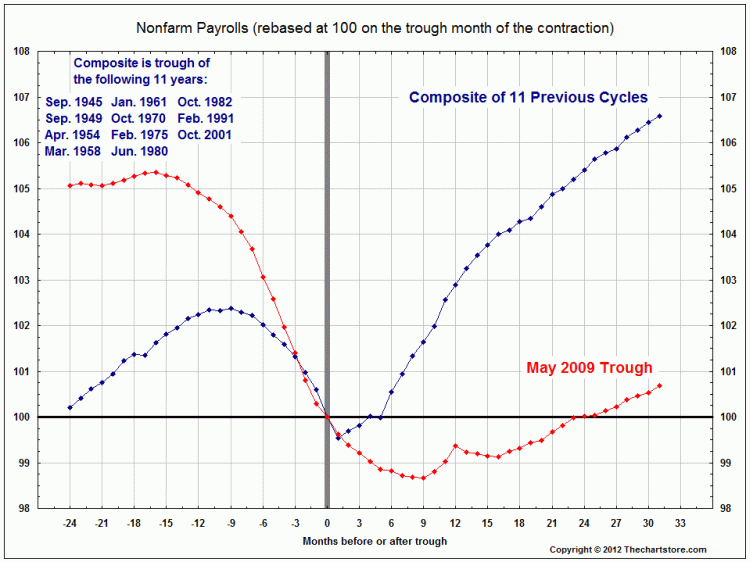
(Chart courtesy of "The Big Picture " blog (Ritholtz); originally from thechartstore.com)

The chart below shows that the recovery from this Great Recession as measured in jobs is considerably slower than the composite of all periods since WWII. Why is this?

My reading and observation convinces me that we are in a period of what I'll call rapid digital productivity (RDP).

We have been through massive technological change in the past, e.g., from manual labor to steam, the Industrial Revolution, and electrification where job dislocation occurred. Employment rebounded because the average Jane and Joe could learn new skills relatively quickly and adapt to the requirements of a new work environment and different industries. Training and apprenticeships enabled most people to cope so that they became employable and could earn a decent wage in these new or expanded industries.

More recently in the 20th Century, institutions such as public education, government, private sector, and union training programs helped people learn new skills and find new jobs in basically the same economy that existed in the former 'good times.'

I believe this era in the 21st Century is different. As digital technologies, massive networks of information, quantum leaps in software capability, miniaturization, robotics and other advances in digital/computer technology (RDP) pervade more industries, the actual work available that requires humans to perform is shrinking. Businesses are finding that they can easily substitute capital investment in these RDP technologies for labor. The inputs required for the same or increased output have become far less labor intensive. That means fewer jobs while growth, albeit more slowly, occurs.

I think we are in the midst of a massive transformation that will continue to reduce the need for labor to produce the goods and services that we need to live reasonably well. Machines and systems will continue to eliminate labor as the RDP technologies are more broadly deployed. Thus, the recovery and growth in the economy to create jobs will be far slower than promised by politicians of all stripes.

Many simply do not understand the radical transformation underway. They may believe that we will return to the 'old days' when jobs came back when a  recession ended. Some leaders prefer to talk about the hollowing-out of the middle class and blame the 'rich' as the problem, seeking a redistribution of wealth as a panacea. The problem is far deeper than that polarizing rhetoric and the solutions exceedingly more difficult than simply changing Presidents or members of Congress.

What has worked historically such as government stimulus and deficit spending may have a short term positive impact by pumping money into the economy. Demand for goods and services and some job growth may result, but this will not suffice for the long term because of the radical nature of the RDP technological transformation underway.

Instead, we need a basic re-thinking of the nature of work and the institutions that provide people the skills and resources to work productively in an economy that has declining need for the traditional skills of middle-class people. The inertia of our institutions far exceeds the increasing momentum of technological change.


A recent (January 2012) analysis of jobs and income in Vermont by the Public Assets Institute fails to even allude to the effects of technology (RDP) in the hollowing out of the middle class in the past decade or two, preferring to resort to political and policy reasons. This leads me to believe that many simply do not understand the deep effect that technology has had on the nature of work and middle class jobs in America.