Congressman Ryan's opinion piece suggests that budget negotiations are essential and some common ground may exist among Republicans and Democrats. And he makes no mention of the Affordable Care Act.
Paul Ryan: Here's How We Can End This Stalemate - WSJ.com:
"Over the next 10 years, the Congressional Budget Office predicts discretionary spending—that is, everything except entitlement programs and debt payments—will grow by $202 billion, or roughly 17%. Meanwhile, mandatory spending—which mostly consists of funding for Medicare, Medicaid and Social Security—will grow by $1.6 trillion, or roughly 79%. The 2011 Budget Control Act largely ignored entitlement spending. But that is the nation's biggest challenge."
'via Blog this'
Showing posts with label debt. Show all posts
Showing posts with label debt. Show all posts


January 26, 2013
Our Deficit/Debt Problem in one Simple Chart
Hat tip to Barry Ritholz for the chart!
Unfortunately TeamObama and the Democrats generally wants to increase the blue dotted line rather than address the real problem of the red line which is excessive spending.
In reality some of both will be needed. Will the real leaders in Congress willing to address this please stand up? Do not be overshadowed by TeamObama's political considerations ahead of the nations financial difficulties that must be addressed.


December 26, 2012
Washington Times, Thomas Sowell: Fiscal Cliff Notes (Part I), 12/4/12
Thomas Sowell is right about politics dominating any serious discussion publicly about the trillion dollar deficits and mounting debt from TeamObama. The hand-wringing about recession and the fiscal cliff is steeped in politics and not serious negotiations to right the nation's fiscal ship.
Washington Times, Thomas Sowell: Fiscal Cliff Notes (Part I), 12/4/12“All the political angst and moral melodrama about getting ‘the rich’ to pay ‘their fair share’ is part of a big charade. This is not about economics, it is about politics. Taxing ‘the rich’ will produce a drop in the bucket when compared to the staggering and unprecedented deficits of the Obama administration.”"
'via Blog this'
Washington Times, Thomas Sowell: Fiscal Cliff Notes (Part I), 12/4/12“All the political angst and moral melodrama about getting ‘the rich’ to pay ‘their fair share’ is part of a big charade. This is not about economics, it is about politics. Taxing ‘the rich’ will produce a drop in the bucket when compared to the staggering and unprecedented deficits of the Obama administration.”"
'via Blog this'
October 24, 2012
Race for President Leaves Income Slump in Shadows - NYTimes.com
Race for President Leaves Income Slump in Shadows - NYTimes.com: "Many of the bedrock assumptions of American culture — about work, progress, fairness and optimism — are being shaken as successive generations worry about the prospect of declining living standards. No question, perhaps, is more central to the country’s global standing than whether the economy will perform better on that score in the future than it has in the recent past."
Some well-reasoned analysis in this piece, most of which I agree with. In the 'silly season' before elections politicians often deal with 'froth' in their campaigns because the underlying forces driving our fiscal mess and poor performing economy cannot be dealt with in a sound bite or 30 second ad.
The fundamental issue in the Presidential campaign is whether the government is the best solver of our economic and fiscal problems of whether the role of the private sector can best do it. I favor the private sector and I think more and more voters are coming around to that viewpoint because they see the trillion dollar deficits of TeamObama have produced poor results and unsustainable debt but little economic improvement.
Missing from the story is the corrosive effect of entitlements on America's fiscal health. Entitlements persuade people who have them not to lose them and to vote accordingly. (Entitlements do little to grow the economy except provide a source of consumer spending.) Politicians know this and too many pander to the recipients for their votes.
The fundamental problems in our economy have no quick fix, yet that's what too many voters unrealistically expect and that politicians over-promise with their 'make sure...' rhetoric.
The only way to improve incomes is to grow the pie (the economy) not redistribute it. Even if all the income of the super-rich was confiscated and applied to the deficits it would be a drop in the bucket.
It boils down to this: Which Presidential candidate and Congresspersons do voters trust to best set a course to solve the problems we face. Romney's proposals ring truer than Obama's.
'via Blog this'
May 13, 2012
World Debt and GDP - Unsustainable
This is the chart I have been looking for. Sorry, but the axis labels are not part of the graphic file. I have described them below. Thanks to Hayman Capital Management, LLC and Kyle Bass, via my dentist, for the lead to finally find it. Here is a comparison of the world's total debt to GDP .
The dire conclusion is that the world's debt has grown at an 11% annual rate in these 9 years from $80 trillion to $220 trillion while the total world's GDP has grown only at a rate of ~4%. This is unsustainable and Bass' conclusion (in late 2011) is that hard defaults are imminent. See the full report and analysis here.
 |
Blue = Public Debt Securities Red = Private Debt Securities Green = Bank Assets Purple Line = Debt/GDP
The left axis is Total Global Debt in $Trillions from 0 at the bottom to $220 Trillion at the top ordinate. The columns are the years 2002 to 2010. The right axis is the Global Debt/GDP Ratio with the bottom axis at 240% to the top at 350%
|
May 7, 2012
Found this chart on Barry Ritholz's blog who reprinted analysis work done by Chris Turner to rebut some opinions and statements in April by Paul Krugman, who favors yet more government deficit spending. Turner's full analysis is here at the Ritholz blog.
My bottom line: Government spending has been out of control since 1978 and Congress is to blame. It's easier to target Presidents, but Congress is the real culprit. They refuse to make the hard choices and persuade the American people of their necessity. Instead, they do everything possible to retain/gain political power rather than address the problems.
Is it any wonder the American public's approval rating of the job Congress is doing is at an all time low of ~18%?
The record of the last 4 years is crystal clear to me. The massive stimulus spending triggered by the near meltdown of the economy in 2008 caused by a combination of extraordinary risky behavior by Wall Street and failed government policies and regulation has failed to resolve the economic doldrums while at the same time creating massive and unsustainable debt. This debt will likely be resolved by devaluing the currency in the future with massive consequences. It cannot possibly be paid off even by our great-great grandchildren.

April 22, 2012
The FED has Few Tools to Fight Inflation or Stimulate the Economy
Thanks to Steven Hansen at Seeking Alpha for this straightforward analysis of The Fed's policy and what seems a long future of near-zero interest rates. Disturbingly, the FED has few tools in the kit to control inflation or stimulate growth.
Meanwhile, Congress dithers as their unsustainable spending binge creates huge deficits and debt that will bury the country. What a sad commentary on our government and society. We need to turn this around, not for the benefit of the "1%," but for the future of the Republic.
A vote for Obama and his policies in November is a vote against the country's prosperous future and a general reduction in our standard of living.
"...Reading between the lines - the Fed is not seeing economic traction anytime soon. Consider that USA monetary policy is based on gold standard conventions which becomes less and less effective as government debt grows. Further modern day monetary policy for a major currency is effected[sic] by leakage and actions by other currencies.
The Fed cannot allow interest rates to raise when:
- the servicing costs of government debt would strangle the economy; or,
- if the government goes on an austerity program, which will contract the economy, and loose monetary policy must prevail to try to mitigate a shrinking economy; or,
In short, the USA is between a rock and a hard place - as it is almost certain that rising interest rates would apply abnormally large brakes on the economy. Realistically, there is little difference between 0% and 0.5%, so politically based monetary policy movements are possible.
- the stalemate in Washington is not allowing long term solutions as the debt continues to grow. Under this circumstance, the Fed must accommodate the lack of leadership for fiscal policy.
Yet, there are too many parallels with Japan (mainly debt plus demographics) to believe the USA can escape economic doldrums without a major shift to a less of a gold standard approach to monetary policy.
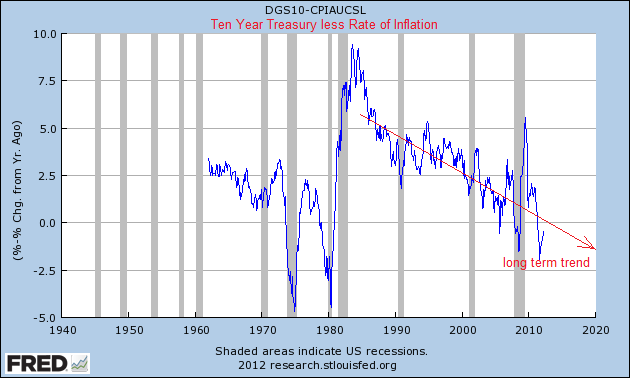
In the meantime, unless you are in the 1% - prepare for a less affluent future. In the olden days (pre-New Normal), your plan for retirement was based on less risky bonds for income and cashing out the old hacienda so that one could make lifestyle decisions. For those already retired, and the boomers - time to look for Plan B as shown on the below chart which shows real return on 10 year treasuries."
(click to enlarge)
April 1, 2012
Spain Now at the Top of the European Crisis Heap
[Hat tip to John Mauldin for sharing this letter in his newsletter from a banker/financier friend after a conference of high level folks in Paris.]
All signs point to continuing crisis in the Eurozone with Spain currently at the top of the heap of pain with massive unemployment and a huge housing bubble, worse than ours. John Mauldin examines it in detail in this week's newsletter.
The United States should be learning a lesson form all this, but TeamObama and the Democrats are placing re-election politics far ahead of fiscal responsibility. Only the Ryan budget makes any sense to begin to fix the mess and keep America from descending into the 'more debt than we can afford' syndrome that plagues Southern Europe.
The United States must reform its entitlements and tax code to encourage fiscal responsibility and continue to grow the economy. No Democrat-sponsored budget plan does that. This is the drum that the Republicans should beat all the way to November.
Back from ParisDavid Kotok
We are back from Paris. The head is filled with new info. For the publicly available portion of the conference, see the GIC website, www.interdependence.org. The remaining comments will be my personal “takeaways” from both public and private conversations. By Chatham House Rule and Jackson Hole Rule, these words are attributable only to me. All errors are mine.
1. In my view, the situation in Portugal is unraveling. This may be the second shoe to drop in the European sovereign debt saga. Now that Greece has paved the way, the speed of unwind with Portugal may be much faster. I do not believe the markets are prepared for that. Runs are affecting Portuguese banks. Euro deposits are shifting to other, safer countries and the banks that are in those countries. Germany (German banks) is the largest recipient. Remember, deposits in European banks are guaranteed by the national central banks and the national governments, not the ECB. There is no FDIC to insure deposits in the Eurozone.
2. The issue is that Greece was supposed to be “ring-fenced.” Notice how European leaders have stopped using that word. Their new word is firewall. If a second country (Portugal) restructures, the sovereign debt issues become systemic rather than idiosyncratic. That becomes the second game-changer. Systemic risk needs big firewalls. We learned that the hard way with Lehman and AIG, which were systemic, vs. Countrywide and Bear Stearns, which were “ring-fenced” – or thought to be ring-fenced at the time.
3. A game-changer was the use (not threat) of the collective action clause by Greece. CAC altered the positions of the private sector. It rewrote a contract after the fact. That is why Portugal’s credit spreads are wide: the private-sector holders of Portuguese debt know that a CAC can be used on them, too. The same is true for all European sovereign debt. A re-pricing of this CAC risk is underway.
4. Private holders of Greek debt had several years to get out before the eventual failure. Those that did not get out were crushed in the settlement. Greece is now a ward of governmental and global institutions like the ECB, IMF, and others. It is unlikely to have market access for years. This is another game-changer. In the old crisis days, the strategy was to regain market access quickly and restore private-sector involvement. In the new Eurozone-CAC crisis days, the concept is to crush the private-sector holders, and that means no market access for a long time. Instead, we will have ongoing and increasing sunk costs by governmental institutions. Caveat: government does not know how to cut losses and run. Government only knows how to run up small losses until they are huge. Witness Fannie Mae in the US. Witness the sequence that allowed Greece to fester for years. Government does not know how to take the “first loss,” which is usually the smallest lost. Government does know how to run up moral hazard.
5. The term moral hazard means the action is done today and the price is determined later, after the chickens come home to roost and crap all over the coop. That is the nature of government everywhere. By the time the chickens return, the political leaders have changed. Those who took the moral hazard risk are gone. Those who inherited their mess are blamed during the cleanup. That is where we are today in Europe. Hence, the political risk is rising daily. Elections could change these governments, and the new governments may repudiate the actions of the old ones. We expect more strikes and unrest. That is how elections can be influenced.
6. European debt-crisis issues are lessons for the US. They belong in the political debate. Both political parties are responsible for our growing debt issues. Bush ran up huge deficits. Obama continued them. Each party blames the other. Neither takes on the responsibility of their actions. We shall see how this evolves between now and November.
I am more pessimistic about peripheral Europe than I have been. All that my co-author Vincenzo Sciarretta and I wrote in our book several years ago is now being reversed by policies. In the beginning, the Eurozone benefited immensely from economic integration and interest-rate convergence. Now it faces disintegration and divergence. Reverse the chapters in the book and play the film backwards.
Can Europe find a stabilizing level and resume growth? Time will tell. Meanwhile, political leaders and central bankers are going to be tested again.
This ain’t over. Yogi is correct.
March 28, 2012
Deficit Reduction Budget Proposals

(Chart from the WSJ March 28, 2012)
The House plans for deficit reduction make more sense than TeamObama's proposal, which is more a political creation than a fiscally responsible budget. Of course, all budgets in an election year are political, but the U.S. must reduce reliance on debt to fund programs and operations. The present course puts us in "Greek mode.'
Cuts are essential, but a revenue increase via a bold revision of the tax code and entitlements reform are necessary to change Congressional spending habits and expectations of Americans. I favor the House GOP Plan.
February 19, 2012
Thoughts From the Frontline - John Mauldin
Below is an excerpt from John Mauldin's weekly newsletter, this issue is titled The Cancer of Debt and Deficits, (John Mauldin | February 18, 2012)
John writes a long newsletter each week full of interesting thought and analysis.
His introduction to this week's piece:
"Taxing ConsumptionSo let's get down to details. I met with Marc Sumerlin for breakfast a few weeks ago, and he later sent me a book he coauthored back in 2007 with Larry Lindsey, called What a President Should Know … but most learn too late. Both men are serious economic thinkers, and Lindsey is a specialist in tax policies. They both worked as economic advisors in the White House, and Lindsey was on the Board of Governors of the Federal Reserve. They do understand some of the mechanics of politics and economics. They now work together at The Lindsey Group, an economic advisory service based in DC. They do excellent work.
Marc outlined to me their thoughts on reforming the tax code. I read the chapter in the book on reforms, and like it better than anything else I have seen.
What they suggest is to tax consumption with a 20% Value Added Tax (VAT). There would be no taxes for incomes under $100,000. None. No Social Security. No Medicare. If you make less than $100,000 you pay nothing.
All income over $100,000 is taxed at 20%, no matter what the source. No capital gains rate or dividend break. I assume that also means no municipal bond exemptions. No exemptions for anything. Every last tax expenditure goes away. Corporate tax rates would be 20%, and again I assume no exemptions. If you make a profit, you pay taxes.
Although they did not say it in the book, they essentially agree with Hobbes that income measures what you contribute to society and spending measures what you take from it.
What society wants (and needs) is more income, as that grows tax revenues and general wealth. Consumption – what you get from society – is taxed. We don't just need to tax millionaires more, we need more millionaires that we can tax. And you get that by encouraging growth in the economy.
They also note that their proposal was revenue-neutral in 2007, and included a $2,000 per child tax credit. Every worker would get an approximate 7.5% pay raise from the removing of Social Security and Medicare taxes. While businesses would also get that same tax break, they would have to pay a VAT on salaries, which would be an increase in cost. Welfare, the social safety net, and health care would all be funded.
As the VAT would not be paid on exports, it would put us on a more even ground with those nations that have a VAT and certainly lower business taxes, both of which would make us more competitive and increase exports and thus employment.
While they did not suggest it, I would change the tax code over four years, although phasing out tax expenditures faster to help the current budget crisis. A sudden change might be disruptive, and it would take time to get the mechanism in place for collecting a VAT. States with individual income taxes would need to adjust the sources of their incomes. (It would also give my tax-accountant and tax-lawyer friends time to find a different career focus.) Businesses would need some time to adjust their costs and sales.
This is different from the so-called "Fair Tax," which is essentially a national sales tax. While I like the idea of taxing consumption, a 20% sales tax on top of state and local sales taxes of 8-10% would encourage much of our economy to move to either a barter system or a cash economy. A VAT might provoke similar reactions on a smaller level, but I think overall it is more readily collectible.
One can adjust the levels of both the VAT and income taxes to match the desired level of government spending. I might prefer less, but that is not the point here. Match these taxes (along with the normal excise taxes) with entitlement reform, a properly structured health-care system, and some cuts in other areas, and you are close to a balanced budget.
One caveat. It may surprise a few readers, but I met with David Krone yesterday for a long breakfast in Washington, DC. David is chief of staff for Senate Majority Leader Harry Reid. He is passionate, articulate, savvy, and an all-round nice guy. We found many areas of common ground and concerns. When I broached the idea of the tax proposal above, he seemed open to it, but came back with one thought.
"It has to have a trigger." I must admit, I had to ask what a trigger is.
"A trigger is a pre-agreed-upon outcome if the desired budget outcome does not happen. Either spending cuts, tax increases, or some combination, but it must be automatic." Quite a reasonable suggestion.
I readily admit there is something for everyone to hate in a VAT tax. It would raise my costs for employees substantially. I would lose several nice deductions. But given our current tax code, I think it would be the better of two evils for the economy.
Do you hate the idea? Then come up with an alternative that collects enough revenue and doesn't have the problems of the current structure, and can get the votes. As I noted above, I would vote for something like Simpson-Bowles if that was my choice. I think Reid and Boehner should introduce Simpson-Bowles for an up or down vote before the next election. Let's see what happens.
January 18, 2012
Recession in 2012? Likely Says Hoisington Investment Management Company
This report is commented on by John Mauldin in his 'Outside the Box' newsletter this week and is also referenced in "The Big Picture" blog/newsletter by Martin Rithotlz
"...In highly indebted countries, governments have expansively taken resources from the private sector through taxing and borrowing. This leaves the private sector with less vigor to produce jobs and increase productivity, and subsequently wealth for its fellow citizens. This theory, which dates back to David Hume's essay, Of Public Credit published in 1752, is now being played out in real time in the United States. We judge that when an economy is expanding in such a meager fashion it is exposed to an increasing frequency of recessions. We expect such a recessionary event to emerge in 2012 [emphasis added]...."
January 2, 2012
Nobody Understands Debt - NYTimes.com
Nobody Understands Debt - NYTimes.com
Krugman is the ultimate Keynesian, even winning a Noble prize for his work. He seems also to posess a massive ego because he's so certain that he's right! But what if he and the Keynesians are wrong?
I'm no economist, but I think he's wrong about government spending and debt because today's and tomorrow's economy is unlike that of the past where the theory arguably worked fairly well.
I believe accelerating technological change makes for a very different economic reality than in the past. I am persuaded that we are entering a future where jobs will continue to disappear because human work, even complex human work, will increasingly be done by powerful computing networks and robotic systems. As this change accelerates, the need for workers with the "middle skills" (the middle-class) will continue to diminish while the population grows.
Of course, people will continue to be needed in certain service work such as plumbers, technical service, equipment and infrastructure maintenance and health care. Lower paying work like food service, agricultural labor, gardening, etc. that aren't yet adaptable to automation will certainly be required.
Higher skilled jobs designing and servicing these complex digital and robotic systems will be in short supply, because people are changing and re-skilling more slowly than technology is advancing. Our institutions and education have inertia that is unequal to the momentum of society's adoption of advancing technology. The economy seems to be much more capital than labor intensive for the same output.
More than likely, so-called structural unemployment will not disappear quickly, but may become worse. This means fewer taxpayers and increasing burdens on society's productive people to support those who receive ever-increasing benefits provided by government spending which now requires borrowing about 40 cents for every dollar spent.
Krugman's approach may have worked for yesterday's economy, but will likely fail tomorrow's reality. He offers scant evidence that increasing government spending and debt will produce the kind of skills and jobs that will be essential to success in tomorrow's economy. Presumably, he's not advocating 'make-work' jobs with debt spending. Or is he?
If his theory and advocacy is wrong, we face government growth and costs that we cannot afford.
Krugman is the ultimate Keynesian, even winning a Noble prize for his work. He seems also to posess a massive ego because he's so certain that he's right! But what if he and the Keynesians are wrong?
I'm no economist, but I think he's wrong about government spending and debt because today's and tomorrow's economy is unlike that of the past where the theory arguably worked fairly well.
I believe accelerating technological change makes for a very different economic reality than in the past. I am persuaded that we are entering a future where jobs will continue to disappear because human work, even complex human work, will increasingly be done by powerful computing networks and robotic systems. As this change accelerates, the need for workers with the "middle skills" (the middle-class) will continue to diminish while the population grows.
Of course, people will continue to be needed in certain service work such as plumbers, technical service, equipment and infrastructure maintenance and health care. Lower paying work like food service, agricultural labor, gardening, etc. that aren't yet adaptable to automation will certainly be required.
Higher skilled jobs designing and servicing these complex digital and robotic systems will be in short supply, because people are changing and re-skilling more slowly than technology is advancing. Our institutions and education have inertia that is unequal to the momentum of society's adoption of advancing technology. The economy seems to be much more capital than labor intensive for the same output.
More than likely, so-called structural unemployment will not disappear quickly, but may become worse. This means fewer taxpayers and increasing burdens on society's productive people to support those who receive ever-increasing benefits provided by government spending which now requires borrowing about 40 cents for every dollar spent.
Krugman's approach may have worked for yesterday's economy, but will likely fail tomorrow's reality. He offers scant evidence that increasing government spending and debt will produce the kind of skills and jobs that will be essential to success in tomorrow's economy. Presumably, he's not advocating 'make-work' jobs with debt spending. Or is he?
If his theory and advocacy is wrong, we face government growth and costs that we cannot afford.
"...So yes, debt matters. But right now, other things matter more. We need more, not less, government spending to get us out of our unemployment trap. And the wrongheaded, ill-informed obsession with debt is standing in the way."
December 4, 2011
The Eurozone 's Stark Choices
Below is an excerpt from writings of John Mauldin, <FrontlineThoughts.com> a financial analyst which sums up the choices facing the EuroZone. December 9 is shaping up as a very big day for Europe and world financial markets.
"...Merkel and Sarkozy have told us they will meet Monday and announce a plan on December 9, when the full eurozone meets. Forget bazookas, this needs the equivalent of a howitzer. They are seemingly intent upon rewriting the treaty, which is the only way that the Germans will go along with any major ECB action. But by my reckoning, a few hundred billion, or even a trillion, is not major action, at least not on the level of what will be needed.
The price for German acquiescence will be a loss of sovereignty and the ability to run deficits of any real size for any appreciable length of time for the countries of Europe. Will the peripheral countries go along? Heck, forget them; will Finland go along? This situation has been coming along since the foundation of the eurozone. The early founders acknowledged that a tighter fiscal union would eventually be necessary if the euro experiment were to survive. And eventually is now. As in this month. Time is running out if they want to forestall a credit crisis that would be worse than 2008.
The world is watching, as what happens in Europe will affect us all, in every part of the globe. It could easily tip the US into recession, and it will only be worse for the emerging markets. For Europe, the Endgame is now. We can only hope they come up with a plan that avoids disorderly defaults and a crisis far graver than 2008. They have no good choices, only difficult ones and disastrous ones. Let us hope they choose wisely.
(And for my fellow Americans, note that we will face the same consequences if we do not get our own house in order, and very soon. This is more than an academic observation.)" [emphasis added]
November 30, 2011
Stocks Surge After Central Banks’ Action on Debt Crisis - NYTimes.com
Sounds like another big bank bailout to me! Let's see what all the talking heads have to say.
'via Blog this'
"“They are trying to prevent them from seizing up global liquidity and capital flows and impacting banks and financial institutions throughout the world,” he said.
Burt White, the chief investment officer for LPL Financial, called the liquidity move “a Band-Aid.”
“It helps to prop up the banks for a while, which is going to buy time for Europe to fix the problem,” he said.
The jump in stocks was also an extension of the turmoil and volatility that have weighed on global markets for more than a year."
'via Blog this'
November 29, 2011
Secret Fed Loans Helped Banks Net $13B - Bloomberg
A fascinating, well researched story by Bloomberg of the massive bailout of banks during the 2008-2009 financial crisis and the secrecy surrounding it. Kudos to Bloomberg and their authors and editors for doing this. Clearly, the financial system was in jeopardy at the time and bold action was necessary. It's the secrecy that surrounded it that we find so egregious along with the fact that far too many bankers and the industry in general benefited to an unwarranted degree.
I'm no financial expert, but it seems to me that the finance industry and the Fed were in cahoots to keep Congress in the dark and, for the most part, impotent during this crisis. One could argue that haste was necessary and a dysfunctional Congress could not be trusted to do the right thing in a speedy fashion. Yet, what does it say about the resiliency of our democracy in time of crisis?
Sadly, these world-rattling events have further relegated Congress to irrelevancy in a time of financial crisis. We continue to see more of it with failure of the Super Committee to rationally rein in the deficits and debt, part of which arose from the frantic efforts to save the big banks and the financial system from collapse.
'via Blog this'
I'm no financial expert, but it seems to me that the finance industry and the Fed were in cahoots to keep Congress in the dark and, for the most part, impotent during this crisis. One could argue that haste was necessary and a dysfunctional Congress could not be trusted to do the right thing in a speedy fashion. Yet, what does it say about the resiliency of our democracy in time of crisis?
Sadly, these world-rattling events have further relegated Congress to irrelevancy in a time of financial crisis. We continue to see more of it with failure of the Super Committee to rationally rein in the deficits and debt, part of which arose from the frantic efforts to save the big banks and the financial system from collapse.
"The Federal Reserve and the big banks fought for more than two years to keep details of the largest bailout in U.S. history a secret. Now, the rest of the world can see what it was missing.
The Fed didn’t tell anyone which banks were in trouble so deep they required a combined $1.2 trillion on Dec. 5, 2008, their single neediest day. Bankers didn’t mention that they took tens of billions of dollars in emergency loans at the same time they were assuring investors their firms were healthy. And no one calculated until now that banks reaped an estimated $13 billion of income by taking advantage of the Fed’s below-market rates, Bloomberg Markets magazine reports in its January issue."
'via Blog this'
November 21, 2011
How Do You Spell Dysfunctional?
BULLSHIT is the proper noun for this statement from the co-chairs of the Select/Special/Super Committee charged with finding $1.2 trillion in deficit reduction in the next 10 years as reported in the WSJ (see below).
Obama is the easy target, but it's our Congress that has failed us. No visible leadership will stand up and vote what must be done to correct our fiscal path. The only credible voice, IMHO, is Paul Ryan in the House of Representatives. He speaks truth. Most of he rest speak nothing but empty partisan rhetoric. Will the real leaders please stand up?
Obama is the easy target, but it's our Congress that has failed us. No visible leadership will stand up and vote what must be done to correct our fiscal path. The only credible voice, IMHO, is Paul Ryan in the House of Representatives. He speaks truth. Most of he rest speak nothing but empty partisan rhetoric. Will the real leaders please stand up?
Deficit Panel Leaders Fail to Reach Deal
"WASHINGTON — After one last bout of fitful but futile talks, Congressional negotiators conceded the obvious: that the joint Congressional committee charged with drafting a deficit reduction package would miss its deadline this week. But they did not quite give up the ghost of a chance that a solution might be found later.
“After months of hard work and intense deliberations, we have come to the conclusion today that it will not be possible to make any bipartisan agreement available to the public before the committee’s deadline,” said a statement issued late in the afternoon by Representative Jeb Hensarling of Texas and Senator Patty Murray of Washington, the panel’s Republican and Democratic co-chairs.
“Despite our inability to bridge the committee’s significant differences, we end this process united in our belief that the nation’s fiscal crisis must be addressed and that we cannot leave it for the next generation to solve,” they said. “We remain hopeful that Congress can build on this committee’s work and can find a way to tackle this issue in a way that works for the American people and our economy.”"
November 12, 2011
Italy Struggles with Austerity, Growth, Debt and New Leadership
http://www.nytimes.com/2011/11/13/world/europe/silvio-berlusconi-resign-italy-austerity-measures.html
Click here for more details of the various changes that are being voted by the Italian parliament.
Italy's politics are far more complicated than ours. This brief summary of the austerity and stimulus measures shows how deeply ingrained is patronage and spending. Italy would benefit enormously if people just paid their legitimate taxes. It's estimated that tax avoidance/evasion in the 'shadow economy' is 22.3% of Italy's GDP.( From this link: "According to a 2007 paper by Austrian economist Friedrich Schneider, the shadow economy in Italy accounted for 22.3% of gross domestic product (GDP), that of Spain 19.3%; Portugal 19.2% and Greece a staggering 25.1%. By comparison, the U.S. shadow economy was 7.2% of GDP. A recent European Union report came up with similar figures.")
"...The measures are aimed at reducing Italy’s $2.6 trillion public debt and increasing growth by selling $21 billion worth of state assets and increasing the retirement age to 67 from 65 by 2026. It also would loosen the power of professional guilds, liberalize municipal services and offer tax breaks for infrastructure and companies that hire young workers..."
Click here for more details of the various changes that are being voted by the Italian parliament.
October 12, 2011
Peter Wallison: Wall Street's Gullible Occupiers - WSJ.com
And the beat goes on... the blame game is rampant on the pages of both the NYTimes and the WSJ. Are some real leaders available who can brush aside this noise and get on with moving this country in a healthy direction?
TeamObama has failed his rabid liberal supporters and the country at the same time. We need some real leadership. Where is it? We need a groundswell of sanity, not partisan ideological talking heads.
Congress has also failed us and shown America its great need for people who truly show by their actions that they put the country first and are willing to make the tough choices that will lead to recovery. The answer is certainly not more government spending and exorbitant debt. I consider Congress the only place this can be remedied as I read the Constitution.
"There is no mystery where the Occupy Wall Street movement came from: It is an offspring of the same false narrative about the causes of the financial crisis that exculpated the government and brought us the Dodd-Frank Act. According to this story, the financial crisis and ensuing deep recession was caused by a reckless private sector driven by greed and insufficiently regulated. It is no wonder that people who hear this tale repeated endlessly in the media turn on Wall Street to express their frustration with the current conditions in the economy.Then there is this:
Their anger should be directed at those who developed and supported the federal government's housing policies that were responsible for the financial crisis."
"Research by Edward Pinto, a former chief credit officer of Fannie Mae (now a colleague of mine at the American Enterprise Institute) has shown that 27 million loans—half of all mortgages in the U.S.—were subprime or otherwise weak by 2008. That is, the loans were made to borrowers with blemished credit, or were loans with no or low down payments, no documentation, or required only interest payments.Of these, over 70% were held or guaranteed by Fannie and Freddie or some other government agency or government-regulated institution. Thus it is clear where the demand for these deficient mortgages came from."
If true, government is clearly to blame for instigating the sub-prime mess by the policies enacted by Congress and the administration.
September 28, 2011
Vermont Tiger: Facing the Inevitable
Tom Pelham, Vermont’s budget commissioner in the Dean administration and tax commissioner in the Douglas administration, has it right in his advice to Congress and particularly, to Vermont's Congressional delegation. It's time for leadership, not politics to reshape our national fiscal insanity.
Vermont’s Congressional delegation should reject President Obama’s American Jobs Plan. It’s a political prop diverting attention, effort and scarce tax revenues from the more essential task of right sizing our federal government and calming fears about a profligate and irresponsible Washington..."
'via Blog this'
September 19, 2011
Obama Deficit Plan Cuts Entitlements and Raises Taxes on Rich - NYTimes.com
Even without the partisan rancor surrounding this proposal, let's put TeamObama's deficit plan in perspective.
The Obama budget previously submitted to Congress for the ten years 2012-2021 totals $45.95 Trillion in spending which creates additional cumulative deficits of $7.2 Trillion. A $3 Trillion reduction amounts to a 6.5% reduction in total spending. The cumulative budget deficits would shrink to $4.2 Trillion and the national debt would rise to approximately $18+ Trillion.
Too bad the article didn't include this relevant information. But political rhetoric and often the media echo chamber fail to give us the full story in order to shape our views.
'via Blog this'
Too bad the article didn't include this relevant information. But political rhetoric and often the media echo chamber fail to give us the full story in order to shape our views.
'via Blog this'
Subscribe to:
Posts (Atom)