December 28, 2009

Heads Should Roll

President Obama had more to say on Dec. 29, 2009:

President Barack Obama said a "catastrophic breach" of security led to the Christmas Day attempted bombing on a Detroit-bound airplane. "A systemic failure has occurred and I consider that totally unacceptable. There was a mix of human and systemic failure that contributed to this catastrophic breach of security," he said.
http://online.wsj.com/home-page?mod=djemalertNEWS

Heads should roll in Amsterdam (and perhaps in the U.S. too) where this terrorist boarded with his bomb materials. The people on that flight were fortunate his scheme failed.

This from the WSJ:

"Investigators in the U.S., Europe, Africa and the Middle East are racing to determine how the son of a Nigerian banker became the first person in eight years to try to set off an explosive aboard a U.S. commercial airliner.

President Barack Obama on Sunday ordered a review of government procedures for screening airline passengers and for tracking individuals suspected of terrorist ties. The administration also said it was tightening security procedures, which airlines and passengers say is already causing delays on international flights.

Lawmakers of both parties expressed concerns that the man charged in the Christmas Day attempt to bomb Northwest Flight 253, Umar Farouk Abdulmutallab, was able to board an Amsterdam-to-Detroit flight with a hidden cache of explosives even though he was on a terrorist watch list."


President Obama in an AP story on 12/29/09 is quoted:

"We will continue to use every element of our national power to disrupt, dismantle, and defeat the violent extremists who threaten us."

This is the right response, but for me "violent extemists" = terrorists. This administration's expunging of the word 'terrorist' from its politically correct vocabulary is foolish nonsense. This bombing attempt was the work of a radical Islamic terrorist.

Kudos to the AP for rightly reporting the story using the words terrorist and terrorism. Obama should continue to use the words, too.

December 27, 2009

Pogo Has It Right

As the year draws to a close, most pundits take stock of what the past year has wrought and push through that minefield with projections about what 2010 will bring.

Perhaps it's because we live in the Twitter and Facebook world of instant, if often banal, communications. Or is it that humankind is naturally inclined toward bad news such as the evils and pending catastrophes that seem to hem us in on all sides? Whatever the stimulus, we have little good news to lift our spirits in this middle time between old year and new.

What I find so terribly frustrating is the state of affairs in our Congress. We see little will or agreement on how to better our country. Instead, nearly everything undertaken in Washington, or at least as it is reported, seems spawned from the pit of politics and power. Winning the political battle overshadows the quest for the common good.

We seem to have traded the country's true need for leadership in very difficult times for the 'get me mine now' constituencies demanding to be accommodated so their votes in the next election will remain with the winners.

This is not how it should be.

Of course, politics and the art of compromise among competing ideas and views fuels our republic, but in today's political battle, the common good has been overtaken by mean-spirited rivalries. Government seems to be winning at the expense of the people.

The answer to this state of affairs lies in our souls and those of our leaders. We can establish rules about campaign finance, term limits and ethics, but until the substance and spirit of the individuals we elect is grounded in a different mindset and belief system, we deserve the leaders we elect.

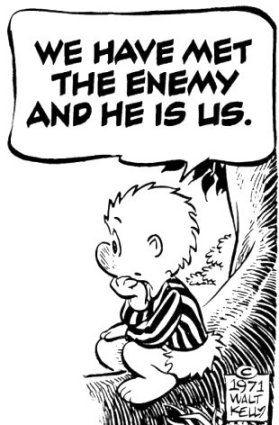
Last century's swamp philosopher, Pogo, had it right: "We have met the enemy and he is us."

December 16, 2009

MIT Forum on "Climategate"

If you have some time to delve into a discussion of "Climategate" by some very bright people at MIT, here's an opportunity to hear/see enlightened views.

Whatever you believe about climate change and mankind's contribution to it, this video is worth watching. If you can't watch all of it, I recommend the interval between minutes 16:00 and 29:21.

Richard Lindzen is a 'skeptic' on the issue of anthropogenic climate change, but he makes a case that is hard to refute on how the 'science' has been distorted, deliberately or otherwise, by advocates.


December 13, 2009

Google to Start Selling Own Phone Without Wireless Partner by Next Year - WSJ.com

Google to Start Selling Own Phone Without Wireless Partner by Next Year - WSJ.com

My ruminations:

Nexus One will be sold at a substantial discount for those who accept advertising on the device. It will have as a fallback feature the easy ability to use WiFi and Google Voice for calling. GV has all the needed elements for call management and voice mail.

The question is what will the carriers charge for service? And will the phone be available in both 3G GSM and EVDO-Rev A? Verizon's recent decision to partner with Google must have taken into account this Nexus One development. My bet is this will enable Verizon, but also the other carriers to seriously challenge the iPhone's dominance. Time to short Apple stock??

I have not read anything about Google and AT&T striking a similar relationship. That probably won't happen until AT&T's exclusive deal with Apple for the iPhone ends.

One thing to be sure of: the technology pundits will have a field day speculating on this development.

Another certainty: Google launch this phone with a very disruptive business model.

The FCC will love it!

And what will be Microsoft's response?

Digital Domain - AT&T Takes the Fall for the iPhone’s Glitches - NYTimes.com

Digital Domain - AT&T Takes the Fall for the iPhone’s Glitches - NYTimes.com

So, this story says that AT&T has a wireless network superior to Verizon's and the sullied reputation of AT&T's network is caused by poor design of the iPhone? Who to believe? I don't have an iPhone and so have no personal experience with either that phone or AT&T's network.

For me, ubiquitous coverage and reliability are most important. Since 2006 I have had Verizon's 3G BroadbandAccess service for laptop use on the road. On a U.S. cross-country RV trip in 2006, I found VZ's service to be broadly available and it has served me well since. I recently upgraded to the MiFi 'modem in your pocket' personal WiFi hotspot, and that's a very nice device that allows both Carol and I (and three others) to be connected simultaneously.

The marketing wars will continue, but now that Google's announcement of an Android phone in 2010 unconnected to a wireless provider is a big deal. Yesterday's initial reports did not state whether it would be available both for GSM networks (AT&T) and EVDO-RevA (Verizon). My guess is they will have a phone for both wireless technologies, although early reports said that Google employees recently had a GSM model to play with.

December 12, 2009

Bankruptcy of a Different Kind

Excerpt from November 2009 newsletter of Ravi Zacharias (Ravi Zacharias International Ministries)

"I find it interesting that apart from a few courageous writers who deal with Islam for what it really is, the common theme in reporting today seems to be to challenge the Christian faith. It is not at all surprising that this is happening at the same time that we are witnessing a worldwide crisis in financial and political matters. The economic turmoil that has resulted from living off resources we didn't have and borrowing that which we could not repay is a consequence of our moral indulgence: We have made moral decisions based on a worldview that has no foundation and that is demanding repayment. We are facing bankruptcy of a different kind."


(www.rzim.org)

Restructure and Refinance of Vermont's Education System

What if... Vermont decided to radically revamp its school system to match 21st century expectations so that our graduates would be readily employable in the healthy private sector we believe we want.

Then, market the daylights out of the change Vermont has embraced and demonstrated it can produce. To make Vermont attractive to nimble, bright entrepreneurial companies will require a workforce from an education platform that has shown itself to be equally nimble and far-sighted.

Same old, same old gets us nowhere. No-brainer across-the-board-cost cutting without radical change won't deliver what we need. We require transformation of our K-12 education paradigm while simultaneously reducing costs. But the inertial forces (think VTNEA and various interest groups invested in resisting change) work against a new, vibrant vision.

Such a transformational change demands leadership and vision, both of which are sorely lacking in Vermont's political class. Or, if it's present, I haven't seen or heard it.

Next week we'll know more when the Legislative Interim Committee on "Financing and effectiveness of the Vermont education system in the 21st century" charged to "examine potential improvements to the structure and funding of the Vermont educational system in light of the state's limited financial resources.

December 10, 2009

FairPoint and Burlington Telecom Threatened by Wireless Services

(Published in the Colchester, VT Sun Dec. 10, 2009)


Wireless Telecom Threatens FairPoint and BT

Two of Vermont's telecommunications providers are mired in painful difficulties. This pain is inflicted by technology, competition, failed expectations, and dubious public policy filtered through the deepest recession in a generation. The outlook is grim. FairPoint Communications, the state's largest provider, has filed for bankruptcy. Burlington Telecom, the municipal enterprise providing services for Burlington customers is over budget, not fully constructed and short on cash.

Both companies are beset with financial problems driven by excessive costs and insufficient revenue to support their operations.

While the Great Recession is certainly aggravating the companies' woes, deeper reasons have led to this state of affairs. Their unrealistic optimism has hit the wall of competition while costs have exceeded earlier rosy estimates.

FairPoint's pain is caused by too much debt and declining revenues because the number of lines is shrinking more than 10% annually. Customers give up landlines in favor of cell phones, switch to a cable company's telephone service, or make phone calls via the Internet. An unsuccessful conversion from Verizon's operations systems caused widespread customer dissatisfaction and substantial extra costs to fix them and to satisfy angry customers. In addition, Burlington Telecom siphoned off revenue from FairPoint as a few thousand customers switched to BT.

Burlington Telecom suffers from costs exceeding estimates, excessive debt and insufficient revenue. Add to this the taxpayer furor caused by city officials acting in apparent direct conflict with Vermont's regulatory rules governing their franchise.

Burlington's dilemma is deeper yet because it is based on the flawed theory that a municipal telecom system would thrive. That notion was crafted by Burlington ideologues who mistakenly believed that a city-owned business was viable in a highly competitive marketplace in an industry where changing technology regularly upsets business plans.

The harsh reality facing both FairPoint and Burlington Telecom is the rapid growth in wireless services. Many types of valuable services are migrating to mobile wireless technology and when Verizon and AT&T install robust fourth generation (4G) wireless technology in the next 2-4 years, wireline companies will shed yet more revenue.

Finding viable remedies will be tough as customers spend increasing time and money on wireless services.

FairPoint must restructure debt in bankruptcy to dramatically reduce the costs of servicing it. Employee concessions will also be required to reduce operations costs. Deteriorating morale and employee defections may impact customer service. Selling or partnering with a financially stronger company may be in FairPoint's and Vermont's best interests.

Burlington Telecom must convince regulators to accommodate its apparent violation of franchise conditions and remedy them. Simultaneously, Burlington must deal with the problem of financing excessive capital and operating costs and persuade Burlington residents to part with yet more revenue. To have a chance at success, Burlington taxpayers and the Public Service Board must demand a viable business plan, one that accounts for the robust wireless services on the horizon.

Meanwhile, the Vermont Telecommunications Authority is charged with creating statewide cell phone and broadband coverage by 2010. They will rely on FairPoint and other telecommunications and cable companies to dramatically expand wireline broadband access.

The smart electrical grid and it's fiber optics component may help provide a more extensive Vermont broadband backbone. Yet, the lion's share of remaining 'last mile' broadband needs may be provided mainly by Verizon Wireless and AT&T using 3G & new 4G technologies.

Widespread deployment and rapid customer uptake of new wireless technologies and services threaten the future revenues of both FairPoint and BT.

Energy Sector Investor - Big Winner

And the winning sector is...

Total return for S&P 500 component stocks
1 yr 5 yrs 10 yrs
S&P 500 Index 30% 2% -8%
Energy 17% 65% 144%
Materials 56% 24% 68%
Industrials 23% -5% 15%
Consumer Discr. 45% -10% -9%
Consumer Staples 19% 35% 58%
Health Care 27% 16% 19%
Financials 23% -45% -27%
Technology 60% 12% -48%
Telecommunication 6% 7% -53%
Utilities 10% 37% 59%
Source: FactSet Research